Articles
Get the Fragletter
New fragrance stories and picks in your inbox. Unsubscribe anytime.
New fragrance stories and picks in your inbox. Unsubscribe anytime.
New fragrance stories and picks in your inbox. Unsubscribe anytime.
New fragrance stories and picks in your inbox. Unsubscribe anytime.
Most people shop for fragrance backwards: pick the bottle first, then try to grow into it. Over 60 percent of scent preferences are shaped by personal style and cultural influences, including unique British traditions, so the useful starting point isn't a shop counter — it's you. Work through these five steps and you'll buy less, and wear more of what you buy.
Your style isn't your wardrobe, though your wardrobe is evidence. It's the rooms you relax in, the music you keep going back to, the impression you'd like to have made before you open your mouth. Bayesian fragrance recommendation models say much the same thing in colder language: scent choices track individual characteristics closely enough to be modelled from them.
So start with questions, not bottles. Do you want to read as clean and professional, or do you want something with weight and shadow? Where will this actually live — an office, a night out, a slow Sunday? Consumer studies on perfume choices point to cultural background and personal history as real drivers of preference, and that usually shows up in what you already own.
Then mine the free data. Compliments count. So does the stranger on a train whose scent made you turn round. Keep a fragrance journal and write down what pulled at you and why, including the feeling — comfort, nerves, calm, the urge to be somewhere else. Skipping this step is why so many wardrobes are stacked with bottles that got worn twice.
Advanced tip: stay open. The fragrance that ends up being yours is often nothing like the one you set out to find.
Fragrance families are a blunt instrument. They're also the fastest way to cut a thousand bottles down to a shortlist of twenty, which is why every serious classification system starts there. The main groups are floral, citrus, oriental, woody and fresh.
Floral leans romantic and delicate through rose, jasmine and lily. Citrus is crisp and quick on lemon, bergamot and orange. Oriental brings spice, vanilla and amber for warmth. Woody grounds everything with sandalwood, cedar and patchouli. If most florals read too pretty to you, woody is usually where you land next.
Here is a summary of major fragrance families and their typical characteristics:
Notes matter as much as families. A perfume is built in layers: top notes open the show and burn off fast, middle notes arrive after 10 to 20 minutes and carry the heart of it, and base notes hold the floor for hours. This is why judging a bottle in the first thirty seconds is the most common mistake made at a counter — you're smelling the trailer, not the film. Standard classification references suggest sampling across families precisely so you learn how those layers behave.
Advanced tip: sample on skin, not paper strips. Body chemistry shifts a scent, sometimes enough to change your mind about it entirely.
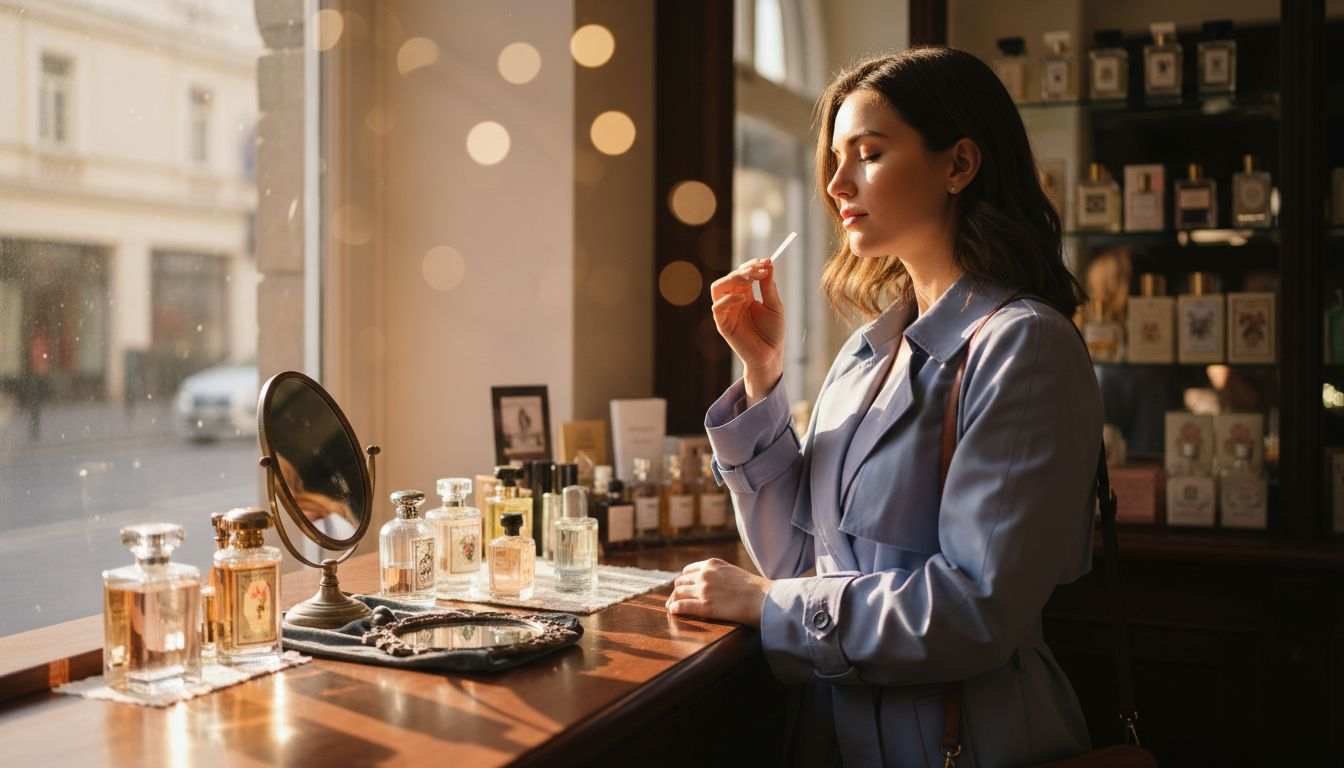
Three fragrances per visit. That's the ceiling, and pushing past it wastes the trip — your nose gives up long before your enthusiasm does. Spray each on a different pulse point, whether wrists, inner elbows or neck, then walk away. Come back after 15 to 30 minutes and see what's actually there once the opening has faded. Don't rub your wrists together either; it bruises the top notes and gives you a false read.
Online sampling plays by different rules. Discovery sets and sample kits let you try a lot without committing to a full bottle, and that's the saner way to explore a family you don't know yet. Look for retailers who publish proper note breakdowns and unfiltered reviews, and check the returns policy before you pay. Packaging is worth a look too: a vial that arrives half-leaked tells you nothing.
Here's how the three sampling routes compare:
| Method | Advantages | Potential Limitations |
|---|---|---|
| In-store | Immediate feedback; real skin test | Limited number per visit |
Advanced tip: keep that journal going. Date, name, first impression, how it moved over the hours, how it made you feel. Six months in, that record is worth more to you than any best-of list.
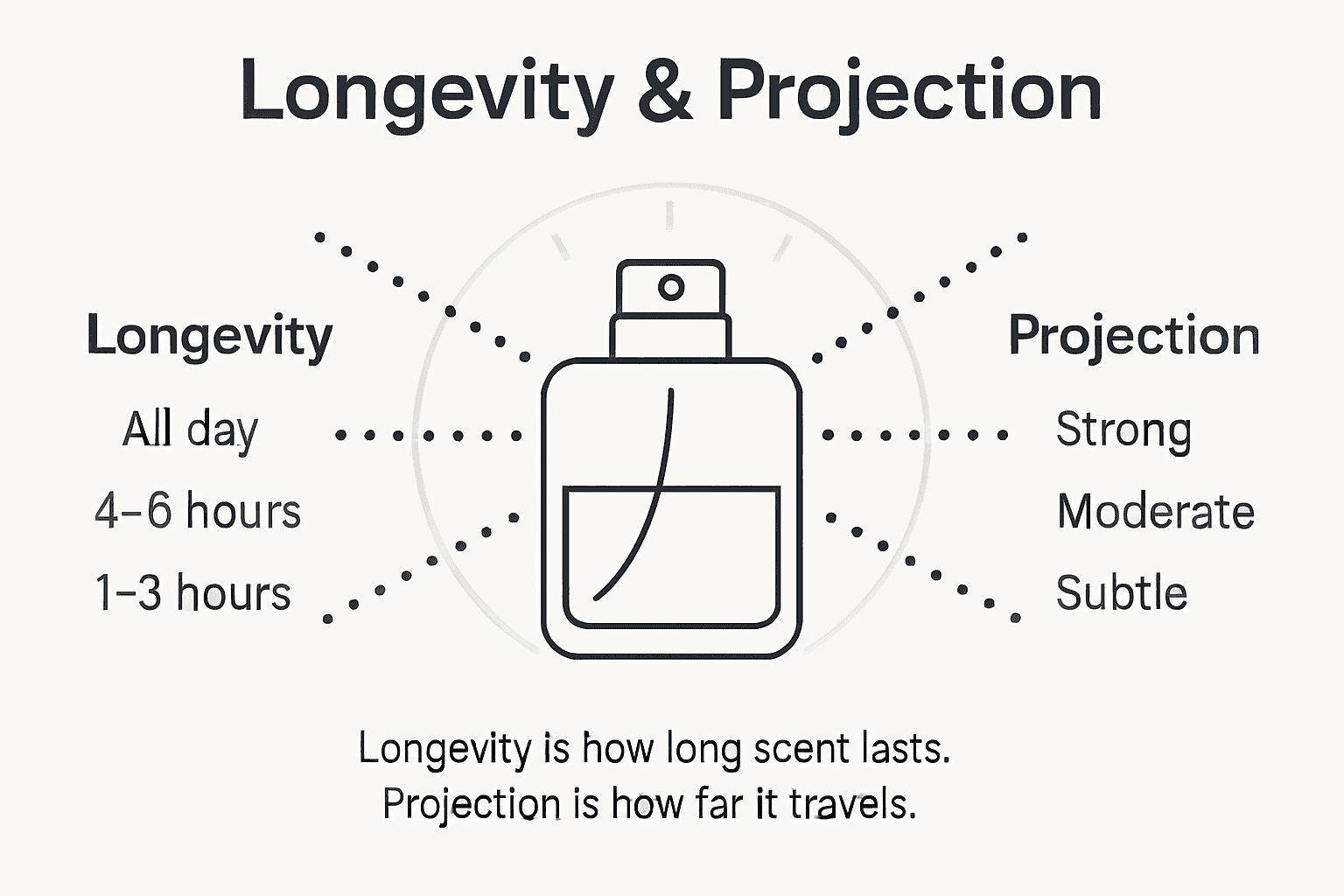
Longevity is how long a scent stays detectable. Projection is how far it carries. They aren't the same thing, and confusing them is why people call a fragrance weak when it's simply worn close — which, for an office, might be exactly what you want. Work on personal perception backs the awkward part: this is a judgement your senses make, and yours won't match anyone else's.
So test it properly. Apply to pulse points where body heat pushes the scent outward: inner wrists, neck, behind the ears. Then wear it for a full day or a full evening instead of ruling on it at the till. Watch the opening, then the heart, then the base. Skin type does real work here — warm, oily skin holds a fragrance longer, while dry skin can eat it.
Conditions matter as much as chemistry. Temperature, humidity and even your diet change how a scent develops, so wear it indoors, outdoors and while you're actually moving, not standing still in a shop. Something that sings in a cold street can turn cloying in a warm room, and you'd rather learn that from a sample than a 100ml bottle.
Advanced tip: treat your own chemistry as the deciding vote. What smells superb on a friend can fall flat elsewhere, so let the wear test outrank the recommendation.
By now you should have your top two or three. Wear each on separate days — a work day, a night out, a quiet one — and pay attention to what the scent does to your mood rather than what the note pyramid promised. Scientific work on scent and human behaviour supports the obvious: fragrance shifts your psychological state, and that shift is most of the reason to wear it.
Ask the plain questions. Does it make you stand differently? Does it pull up a memory? Does it settle you or wind you up, and is that what you wanted this morning?
Then get a second opinion, but choose your source. Friends and family can tell you whether it reads as you; a stranger can only tell you whether it smells nice. Perfumery experts push samples and patience for a reason — the interaction between a scent and the person wearing it is the whole point, and it takes longer than an afternoon to judge. Trust your instinct, and still listen to the person who's known you longest.
Advanced tip: give your choice a story. When you'll wear it, what it's for, who you are in it. It sounds soft, but knowing why a bottle is yours is what stops you buying the next one on impulse.
Here's the verdict: the step people skip is the first one, and it's the one that saves the most money. Decide who you're dressing before you decide what you're wearing, then buy samples rather than bottles until something earns its place on the shelf. Families, notes and performance are all just narrowing tools after that.
Join a community of fragrance lovers at Fragplace, where you can dig into detailed fragrance information, post what you've found and read reviews written by people who actually wear the things. Scent of the day reminders, video reviews and discussions with experts will sharpen your read on families and notes faster than any single guide can. Two things to do next: build your shortlist using the five steps above, then pressure-test it against people who've already lived with those bottles. Visit https://fragplace.com and get started.
Start with your personality, your routine and the way particular scents make you feel, not with a shopping list. Think about the rooms you enjoy and the impression you want to make, then keep a fragrance journal so the pattern in what you like becomes visible.
Floral, citrus, oriental, woody and fresh. Learn the typical notes and the impression each family gives, and you'll be able to rule out most of a shop before you've smelled anything in it.
Cap it at three fragrances, one per pulse point, and give each 15 to 30 minutes before passing judgement. Don't rub them into your skin, and note down how each one moves across the day — the opening is the least useful part of any perfume.
Longevity is how long it lasts; projection is how far it travels from you. Test on pulse points across different settings, and remember that skin type and environment can change the result more than the price on the box.
Wear your finalists in different settings and watch what each one does to your mood over a full day, not a first spray. Then ask people who know you well whether it reads as you — that's the check that catches an expensive mistake before you make it.
| Key Message | Explanation |
|---|
| 1. Understand your personal style | Assess how your personality and lifestyle influence your fragrance choices to identify your ideal scent profile. |
| 2. Familiarise with fragrance families | Explore different fragrance categories such as floral and oriental to find scents that resonate with you. |
| 3. Sample fragrances effectively | Test fragrances on your skin while noting their development over time, avoiding olfactory fatigue. |
| 4. Evaluate longevity and projection | Consider how long a fragrance lasts and how far it projects from your skin in various environments. |
| 5. Reflect on emotional responses | Connect your fragrance choice with your emotions and gather feedback from trusted friends for confirmation. |
| Fragrance Family | Typical Notes | Main Sensory Impression |
|---|
| Floral | Rose, jasmine, lily | Romantic, delicate |
| Citrus | Lemon, bergamot, orange | Fresh, energetic |
| Oriental | Vanilla, amber, spice | Warm, exotic |
| Woody | Sandalwood, cedar, patchouli | Earthy, grounded |
| Fresh | Herbs, green leaves, aquatic notes | Clean, invigorating |
| Online Kits |
| Wider variety; convenient |
| No instant experience |
| Discovery Sets | Affordable way to explore | Scent may differ on arrival |