Articles
Get the Fragletter
New fragrance stories and picks in your inbox. Unsubscribe anytime.
New fragrance stories and picks in your inbox. Unsubscribe anytime.
New fragrance stories and picks in your inbox. Unsubscribe anytime.
New fragrance stories and picks in your inbox. Unsubscribe anytime.
The bottle is the worst place to judge a perfume, and the counter assistant is the second worst. Over 90 percent of new scents never become classics in the British perfume industry, so the odds that whatever is being pushed at you this month turns out to be your scent are slim. Here's the method for finding the one that is.
Your skin isn't neutral ground. The same formula can read sweeter on one person and sharper on another, which makes "it smelled brilliant on her" one of the weakest reasons to buy anything. Research suggests that individual body odour interacts intimately with fragrance, and that people gravitate towards perfumes that complement their natural scent profile. So the real question isn't whether something smells good. It's whether it smells good on you.
Start with the evidence you already have. Think back through the fragrances you've enjoyed and look for the thread running between them — woody, floral, citrus, oriental. Two or three favourites usually give the game away.
Then pay attention to how a scent makes you feel, not just what it smells like. Certain families reliably pull up a specific mood or memory, and that reaction is useful information. Working through fragrance samples lets you cover several profiles without committing to a full bottle, which is how this should be done anyway. You're building an instinct for what suits you, not a shortlist of what's selling.
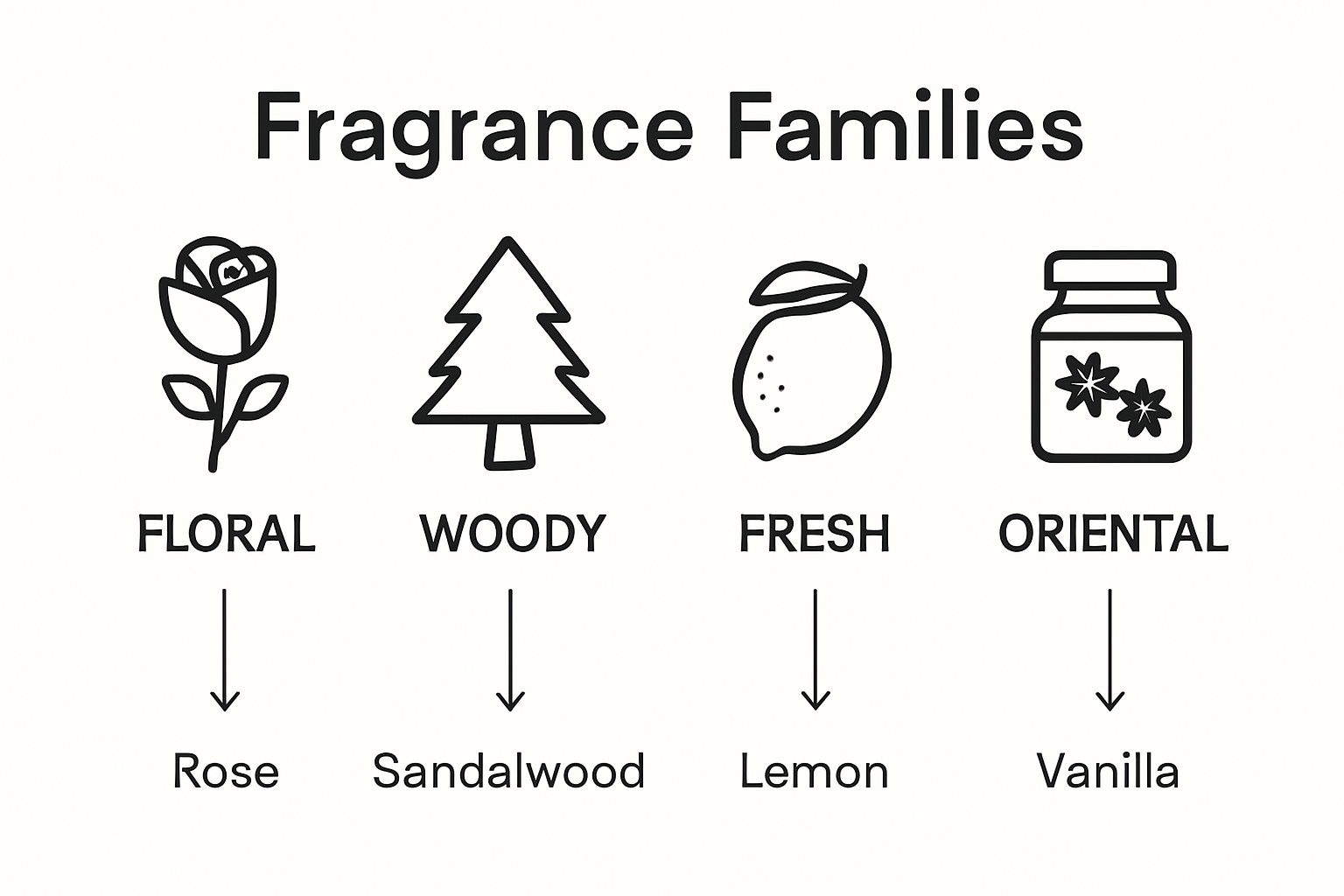
Families are a map, not a cage — but you can't navigate without one. The main five are floral, fresh, woody, oriental and gourmand, and each one carries a different temperament.
Floral leans on rose, jasmine and lily, and gets written off as the safe, romantic option far more often than it deserves. Fresh is the crisp end of the spectrum, built from citrus and aquatic elements: easy to wear, easy to forget. Woody brings the weight, and cedar, sandalwood and patchouli are what give a fragrance depth rather than just brightness. Oriental goes richer again, with spices and amber doing the work. Gourmand is the riskiest of the five — vanilla and caramel are lovely in small doses and cloying in large ones, so if most sweet scents read as pudding to you, start somewhere else.
Sampling across families beats reading about them. Work through the fragrance note categories and notice which ones you keep circling back to. Keep the caveat in mind, though: personal chemistry shapes what you perceive, so a fragrance that's stunning on someone else can land completely differently on you.
Online research narrows the field. It can't make the decision. Detailed descriptions, sample sets and virtual try-on tools are good for building a shortlist and saving yourself a wasted trip into town, and sample sets are the most honest of the three because they put the thing on your skin. Many fragrance communities carry user reviews and long-form accounts worth reading — with a pinch of salt, since everyone is describing their own skin, not yours.
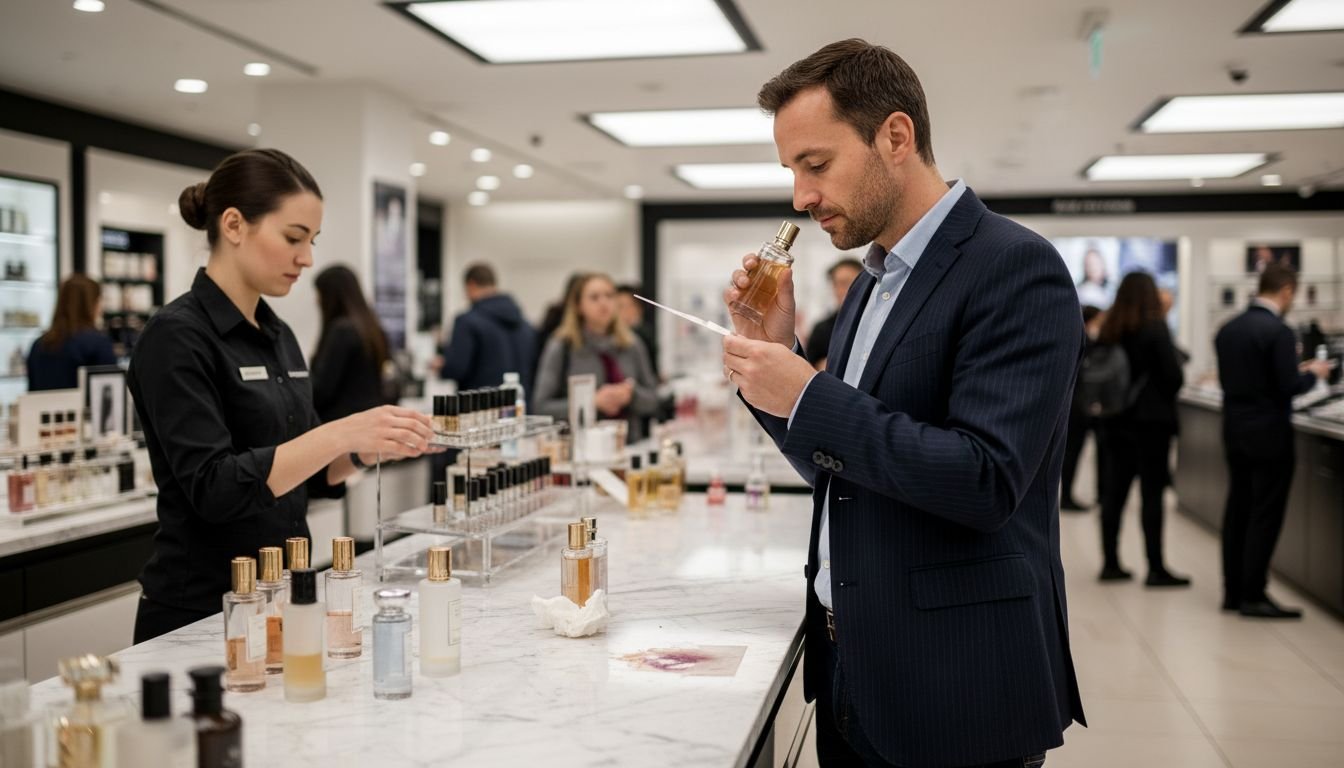
In store, work methodically. Spray onto paper strips first for an initial impression, then apply sparingly to your inner wrist. Give it at least 30 minutes before you judge anything: the opening is the marketing, the drydown is the fragrance. Cap yourself at three per session, because olfactory fatigue arrives sooner than you'd like and everything after that is guesswork. And remember that a strip can flatter a scent that falls apart on skin.
A first impression tells you next to nothing about living with a fragrance. Individual biochemistry shapes how a perfume develops and how it's perceived over the course of a day, so the only honest test is a full day of wear.
Track the movement. How strong is the projection early on, how long does the scent stay detectable, and does it settle into something you want to keep smelling? Some perfumes peak in the first hour and then quietly give up.
Keep a fragrance journal. It sounds fussy; it's the quickest way to stop buying the same mistake twice. Write down the first impression, what it's doing several hours later, and your emotional response to it. Then weigh the practical side — is it appropriate at work, does it hold up socially, do you actually enjoy being around it? Perfume communicates something about personality whether you intend it to or not, so a great one should smell good and also make you feel like yourself.
This is the step most people skip, and it's why so many wardrobes are full of near misses. Selecting a perfume is a matching exercise between the fragrance and your own scent profile, and the verification is watching how that match holds from first spray to final drydown.
Wear your shortlist through the settings you actually inhabit: professional, social, intimate. A scent that's perfect at a party can be overbearing in a meeting room, and versatility is worth testing rather than assuming.
Buy a sample or travel size before you buy the bottle. Always. A full bottle chosen on a ten-minute counter test is a gamble with a poor hit rate. Then ask a friend who'll be honest — you go nose-blind to your own fragrance long before anyone else does, so their opinion is worth more than another sniff of your own wrist. If it keeps coming back positive across scenarios and across people, you've found it.
If you take one thing from this, take this: samples first, bottles later. The families give you a direction, a full day of wear gives you the truth, and a second opinion catches what your own nose has stopped registering. Everything else is shopping.
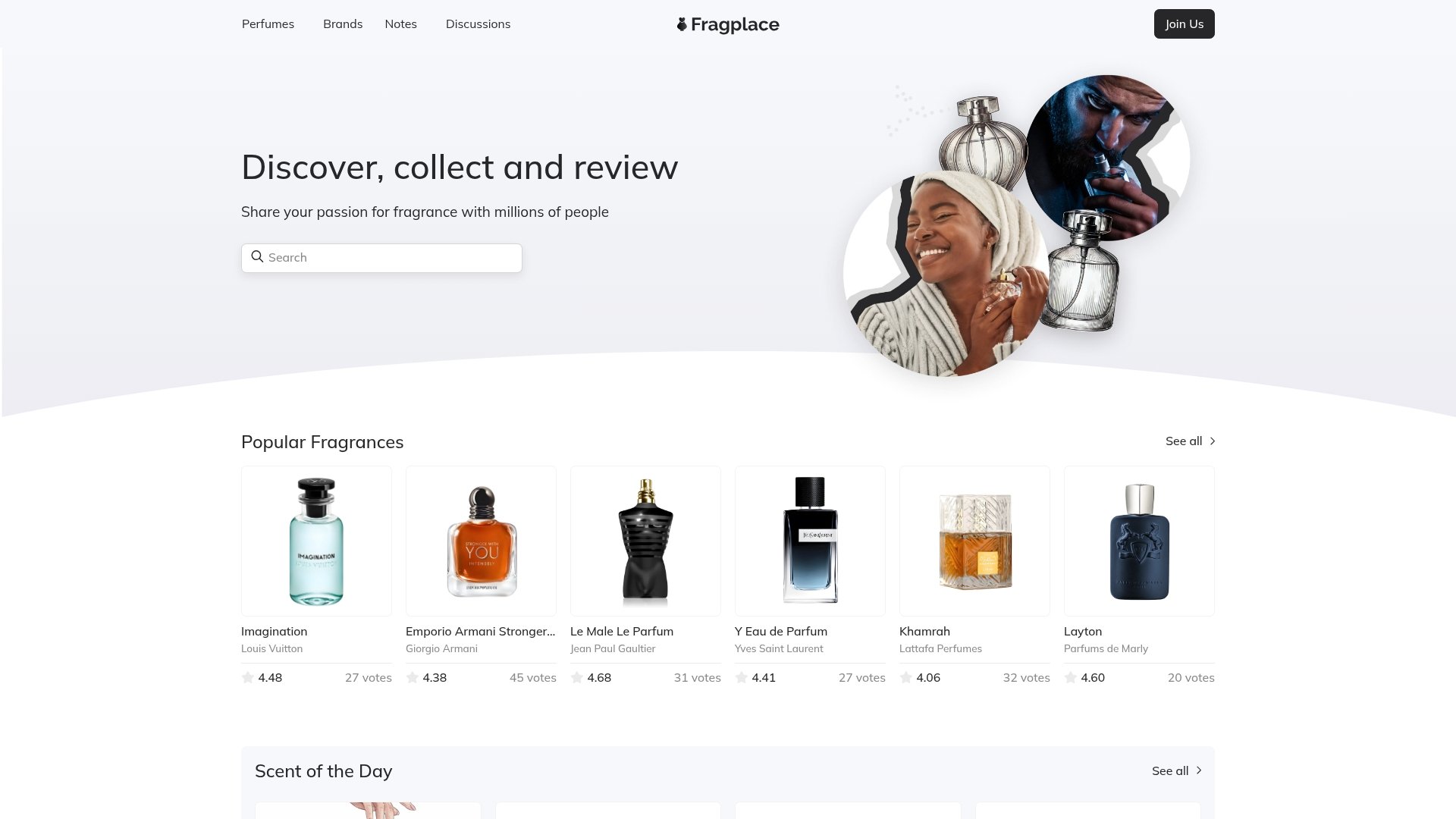
Start by browsing the fragrance note categories to pin down which families you keep returning to. Then bring your shortlist to Fragplace, where honest reviews and discussion from people who've already tested what you're considering will tell you what a product page never will.
Look backwards first. List the fragrances you've enjoyed and find the common thread — woody notes, florals, something else — then test samples along those lines and notice which ones you want to keep wearing rather than simply admire.
Floral, fresh, woody, oriental and gourmand. Sample across all five, including the ones you assume you'll dislike, because assumptions about whole families are wrong more often than they're right.
In store: paper strips for the first pass, then a light application to your wrist for anything that survives it. Online: use sites with detailed descriptions and sample sets so you can test at home instead of committing to a full bottle on the spot.
Wear it for an entire day and track the arc. Note when the scent shifts, how long it stays detectable, and how it behaves on your skin over the hours — that development matters far more than how loud the opening is.
Test it in the settings you'll actually wear it in, social and professional both, using a sample or travel size rather than the full bottle. Then ask a friend who'll give you a straight answer about how it suits you.
| Key Point | Explanation |
|---|
| 1. Understand your scent preferences | Reflect on how your skin chemistry interacts with fragrances to find scents that genuinely resonate with you. |
| 2. Explore fragrance families | Familiarise yourself with categories like floral, woody, and oriental to identify which notes suit your personality. |
| 3. Test fragrances strategically | Use both online resources and in-store testing to evaluate how perfumes evolve on your skin. |
| 4. Assess longevity and fit | Wear each fragrance for a day, noting how it changes and whether it boosts your confidence in various settings. |
| 5. Verify your final choice thoroughly | Test your preferred scent in different scenarios and seek feedback to ensure it complements your natural essence. |