Articles
Get the Fragletter
New fragrance stories and picks in your inbox. Unsubscribe anytime.
New fragrance stories and picks in your inbox. Unsubscribe anytime.
New fragrance stories and picks in your inbox. Unsubscribe anytime.
New fragrance stories and picks in your inbox. Unsubscribe anytime.
Most people don't have a fragrance problem. They have a method problem — too many bottles, ten minutes at a counter, and an assistant paid to hand you whatever launched last month. Get the process right and the bottle sorts itself out.
Your signature scent isn't sitting on a shelf waiting to be found. It's decided by how you live, and the sooner you audit that honestly, the less money you waste. Scent preference is tangled up with memory and personality, which is why two people can smell the same thing and disagree completely.
So start with your diary, not the display. Daily routines, professional environment, who you spend time around, how you dress. An outdoorsy type usually lands on something fresh and crisp. Someone in a quiet office tends to want the understated option that nobody feels obliged to comment on. Lighter citrus notes do the daytime job well; richer, deeper scents belong to evening social events, when you're not trapped in a lift with fourteen colleagues.
Then map that onto the families. Floral gets read as romantic, woody and spicy as more dynamic — take those as orientation, not instruction, because plenty of people wear the opposite of their personality on purpose and it works. The better test is emotional. Does the perfume make you feel more like yourself, or like you're wearing a costume? If it's the costume, put it down, however good it smells in the air.
Top Tip: Keep a fragrance journal. Note which perfumes land, in which mood and which setting — the pattern shows up on paper long before it shows up in memory.
Notes are the vocabulary. Families are the grammar. Exploring the diverse categories of fragrance notes is the fastest way to stop saying "I like the fresh one" and start saying what you actually mean.
Five families cover almost everything you'll meet. Floral (rose, jasmine, lily). Oriental (vanilla, amber, musk). Woody (sandalwood, cedar, patchouli). Fresh (citrus, marine, green). Aromatic (herbs, lavender, bergamot). Each drags a reputation behind it: floral often suggests femininity and romance, woody is supposed to convey strength and sophistication. That's cultural shorthand rather than law. Useful for finding your bearings, useless as a rule about who's allowed to wear what.
Here is a comparative overview of primary fragrance families and their typical personalities:
Sample across all five before you decide you're a woody person. That assumption is wrong more often than it's right. Some people end up drawn to the complicated stuff — multi-layered blends that shift every hour and reward paying attention. Others are happiest with one idea executed properly, and there's no shame in that; a clean cedar or a good lavender will outlast most of the clever ones. Collect testers, wear them singly, and watch how the notes behave over a full day rather than a full minute.
Pro Tip: Write your reaction down the moment you have it. "Turns sweet after an hour" is worth far more to you later than a star rating.
Blotter paper tells you what a perfume smells like. Your skin tells you what it smells like on you, and those are frequently two different perfumes.
Apply a small amount to pulse points — inner wrists, behind the ears, the crook of the elbow. Those spots run warm and help the scent open up. Don't rub it in. Rubbing breaks down the molecular structure and blunts exactly the part you paid for. Let it settle and breathe instead, and watch which notes surface over the next few hours. One perfume per day, no more. Push past that and olfactory fatigue kicks in, at which point the fourth thing you smell is just a smudged version of the third.
Record what happens as it moves from top notes through the heart to the base. Longevity. Sillage, meaning the trail it leaves behind you. And the plain question of how it makes you feel. Confident? Relaxed? Energised? That last part sounds soft, but it's the one that decides whether a bottle gets used or gathers dust on a shelf.
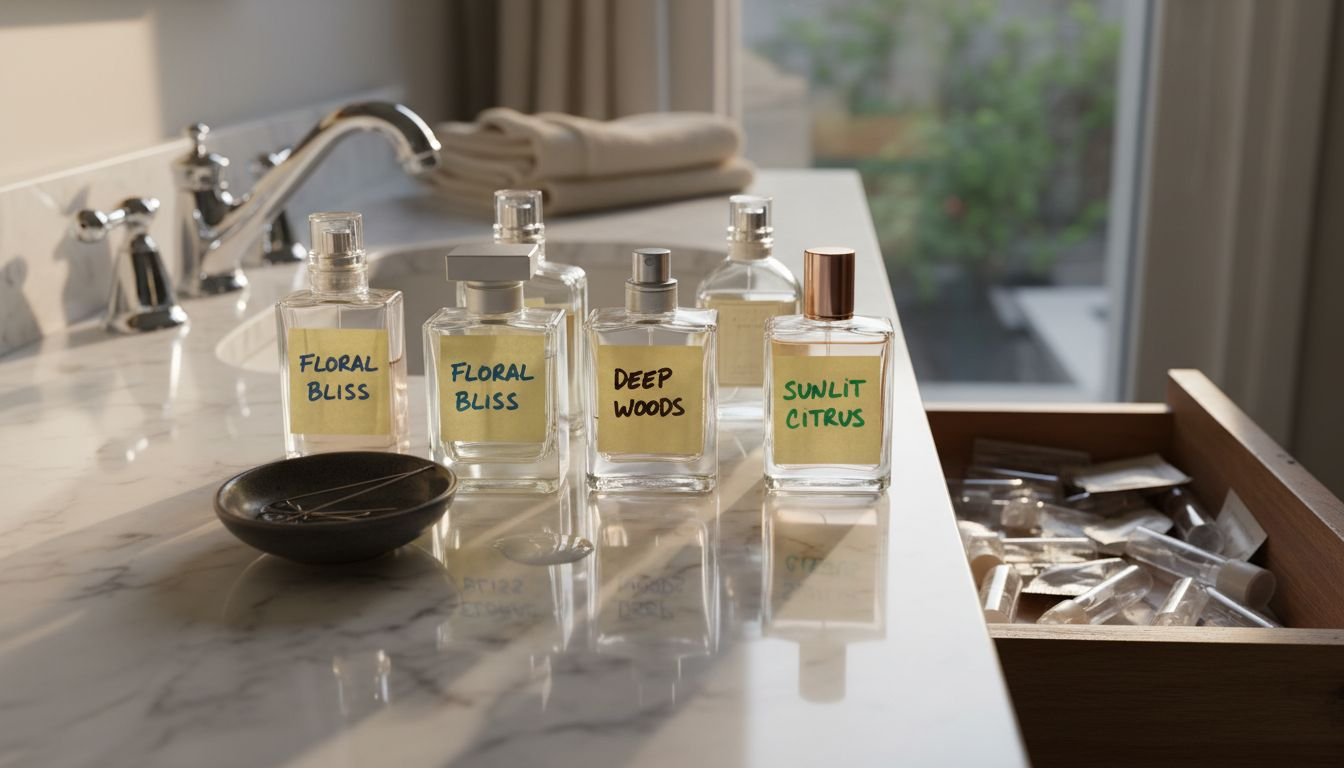
Pro Tip: Photograph your notes and your sample vials as you go. A visual record beats trying to recall which of six near-identical amber samples was the good one.
No brand will tell you its fragrance goes quiet after ninety minutes. Other wearers will, in some detail, and usually for free. That's the whole argument for reading communities before you buy.
Work through forums, review platforms and specialised communities with a sceptical but open mind. Skip the one-line ratings. The reviews worth your time describe character, how the thing behaves at hour four, and where it surprised the writer. Weight the opinions of people whose skin chemistry or lifestyle resembles yours — someone working outdoors in the cold is describing a different perfume from someone in a heated office, even when it's the same juice.
Read several before deciding anything. One review tells you about one person; a dozen start telling you about the perfume. Set professional critiques next to what actual owners say and buy on the overlap, not on the press release.
Pro Tip: Keep a personal collection of the reviews that turned out to be right. A shortlist of reviewers whose noses match yours is worth more than any brand description.
A first impression is the least reliable data you'll ever get from a perfume. They open loud. Plenty of loud openings have collapsed by lunchtime.
Test it properly: same fragrance, different days, different temperatures. Apply in the morning and check in every few hours, noting the drop-offs as it works through top, heart and base. Watch projection and sillage rather than only whether you can still smell it with your nose pressed to your wrist — you go nose-blind long before the room does. Some perfumes start vibrant and vanish. Others need body heat and only become interesting after an hour, which is a fair trade if you know it's coming.
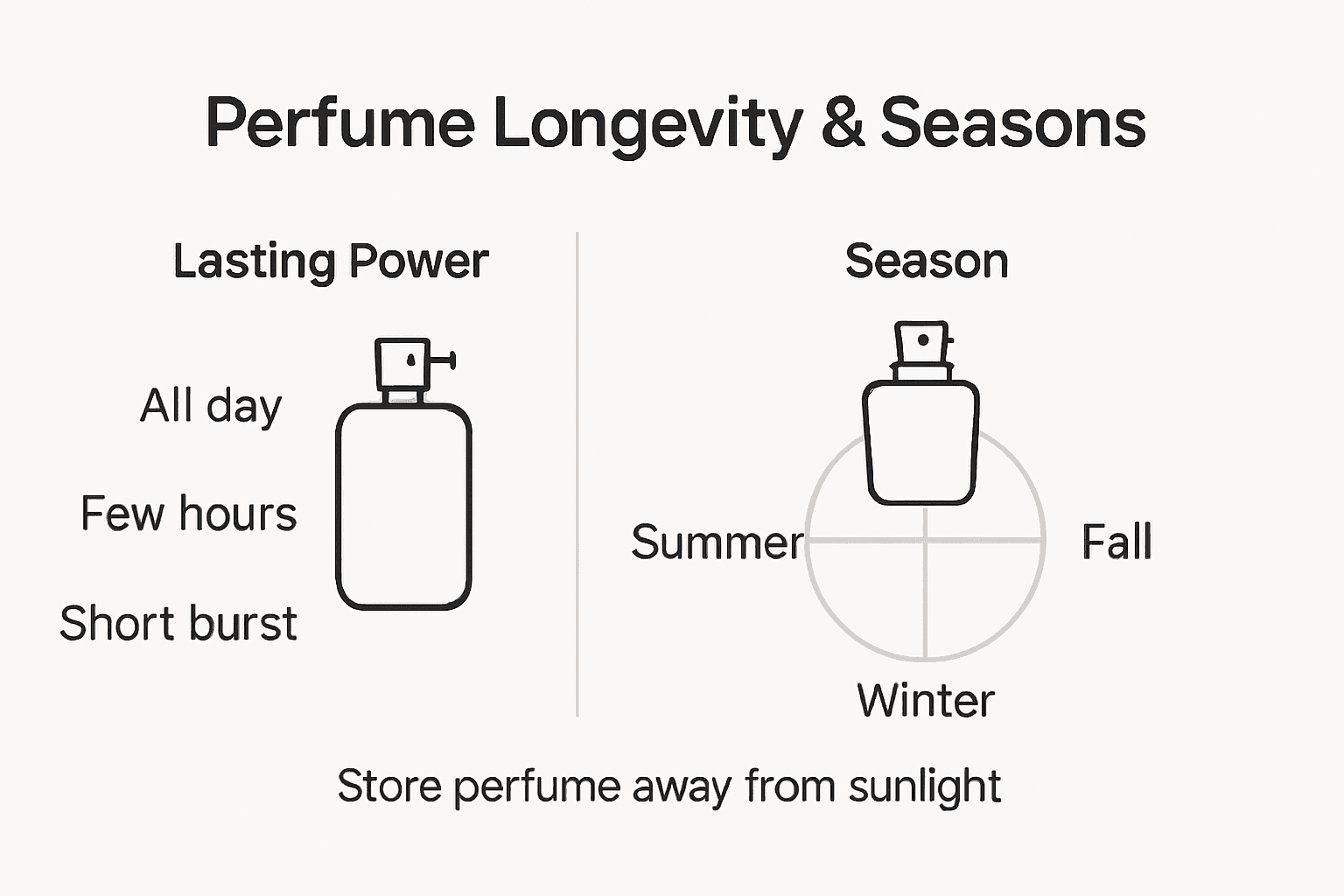
Season matters more than most buyers allow for. Light, fresh citrus and aquatic scents earn their place in warm summer months, where anything heavy turns cloying by midday. Deeper, more concentrated oriental and woody fragrances need cool autumn and winter air to read properly. Build a small wardrobe rather than hunting for the one bottle that covers every condition, because that bottle doesn't exist.
Compare how perfumes perform across seasons for best selection:
| Season | Ideal Fragrance Type | Key Benefit |
|---|---|---|
| Spring/Summer | Light, fresh, citrus | Refreshing in warm weather |
| Autumn/Winter |
Pro Tip: Store bottles away from direct sunlight and temperature swings. Heat degrades the juice, and a badly kept bottle performs worse than the same fragrance stored properly.
If you only take one step from this list, take the skin test. Everything else is preparation for it. The families give you a map, the community narrows the shortlist, but the only evidence that counts is how a perfume behaves on you across a full day. Skip that and you're buying someone else's taste at your own expense.
Two things to do next, in order. Get the vocabulary first: Exploring the diverse categories of fragrance notes turns vague preferences into something you can search for. Then take it to people who'll argue with you — Fragplace is where you can keep your fragrance journal, read what other wearers made of a bottle before you spend on it, and find out whether the hype held up.
Look at your week rather than the shelf: daily routines, professional environment, social interactions, personal style. Keep a fragrance journal and log which perfumes land in which mood and occasion — the pattern emerges faster on paper than it does in your head.
Floral, oriental, woody, fresh and aromatic. Learn what each one actually smells like and sample from all five before you decide which camp you belong to, because that first assumption is often the wrong one.
Small amount on the pulse points, no rubbing, then leave it alone and let it unfold. Track it through the day, since top notes flatter everything — judge a perfume on its heart and base.
They tell you what a product description never will: character, longevity, and what the thing is doing hours after you sprayed it. Gather several perspectives from forums and review platforms instead of trusting one enthusiastic post.
Wear-test it more than once, in different environments, and note when it fades. Then think seasonally — light scents for summer, deeper ones for winter — and accept that a proper wardrobe needs more than one bottle.
| Key Insight | Explanation |
|---|
| 1. Define your scent preferences | Reflect on your lifestyle and personality to find a suitable fragrance family. |
| 2. Explore fragrance families | Familiarise yourself with main scent categories and their associated personalities. |
| 3. Test perfumes on your skin | Apply fragrances to pulse points and observe their evolution throughout the day. |
| 4. Leverage community insights | Read reviews from fragrance communities for authentic feedback and experiences. |
| 5. Assess longevity and seasonality | Conduct wear tests in varying conditions to evaluate lasting power and seasonal suitability. |
| Fragrance Family | Signature Notes | Associated Personality |
|---|
| Floral | Rose, jasmine | Romantic, gentle |
| Woody | Sandalwood, cedar | Sophisticated, bold |
| Oriental | Vanilla, musk | Sensual, mysterious |
| Fresh | Citrus, marine | Energetic, outdoorsy |
| Aromatic | Lavender, herbs | Calm, classic |
| Woody, oriental, spicy |
| Deep, warming, long-lasting |
| Year-round | Versatile blends | Flexible for any climate |