Articles
Get the Fragletter
New fragrance stories and picks in your inbox. Unsubscribe anytime.
New fragrance stories and picks in your inbox. Unsubscribe anytime.
New fragrance stories and picks in your inbox. Unsubscribe anytime.
New fragrance stories and picks in your inbox. Unsubscribe anytime.
Most fragrance disappointments aren't the perfume's fault. A scent that's gone by lunch is usually the result of the wrong concentration, dry skin and a bottle that's been living somewhere warm. Fix those and you'll get more out of everything you already own.
| Point | Details |
|---|---|
| Fragrance Longevity Checklist | Understanding factors like concentration, skin chemistry, and application techniques is essential to enhance fragrance duration. |
| Fragrance Types and Longevity | Different fragrance categories vary in oil concentration and longevity, with Parfum lasting the longest. |
| Application Techniques | Applying fragrance to pulse points and avoiding rubbing can significantly improve scent projection and longevity. |
| Storage and Care | Proper storage conditions and careful application methods are crucial for maintaining the integrity and life of perfumes. |
A fragrance longevity checklist is a systematic way of working out why one perfume clings to skin and clothing while another disappears. It's less about the perfume than about the conditions you give it.
Longevity depends on several things at once: ingredient composition, molecular structure and the way a scent is applied. None of that is exotic chemistry. It's simply why two people can wear the same bottle and report wildly different results, and why the same bottle behaves differently on you in February and in August.
The checklist itself covers concentration levels, skin preparation, application method, storage conditions and your own body chemistry. Storage is the item most collectors skip, and it's the one that quietly wrecks bottles you paid real money for.
Pro Tip: Keep a notebook tracking how different fragrances behave on your own skin — the patterns show up faster than you'd expect.
Fragrances are sorted by how much aromatic material they carry, and that concentration sets the rough ceiling on how long they last. It also explains why the same juice appears at three price points wearing three different names.
The range runs from the lightest Eau de Cologne to the most concentrated Parfum. Eau de Cologne typically lasts 2-3 hours, containing approximately 2-4% perfume oils. Eau de Toilette extends to 3-5 hours with 5-15% concentration, while Eau de Parfum provides a more substantial 5-8 hours of wear with 15-20% perfume oils. Parfum, the most concentrated variant, can last 8-12 hours with 20-40% perfume oil content. Worth saying plainly: concentration isn't quality. A bright citrus Eau de Parfum can fade before a resin-heavy Eau de Toilette, because the materials evaporate at their own pace regardless of what the label promises.
Here is a quick comparison of fragrance types and their typical longevity:
| Fragrance Type | Oil Concentration (%) | Typical Longevity | Olfactory Intensity |
|---|---|---|---|
| Parfum | 20-40 | 8-12 hours | Strongest |
| Eau de Parfum | 15-20 | 5-8 hours | Strong |
| Eau de Toilette | 5-15 | 3-5 hours | Moderate |
| Eau de Cologne | 2-4 | 2-3 hours | Light |
Treat those hours as a starting point, not a promise. Skin chemistry, humidity, temperature and application technique all pull the number around, and skin moisture, body temperature and personal pH can shift a scent's behaviour from one week to the next. Unisex fragrance variations show how tangled this gets, with some scents performing differently across various skin types.
Pro Tip: Apply fragrances to pulse points like wrists and neck, where body heat helps diffuse and prolong the scent through the day.
How you spray matters more than most people admit. Two people with the same bottle can get results hours apart, and technique explains a good share of the gap.
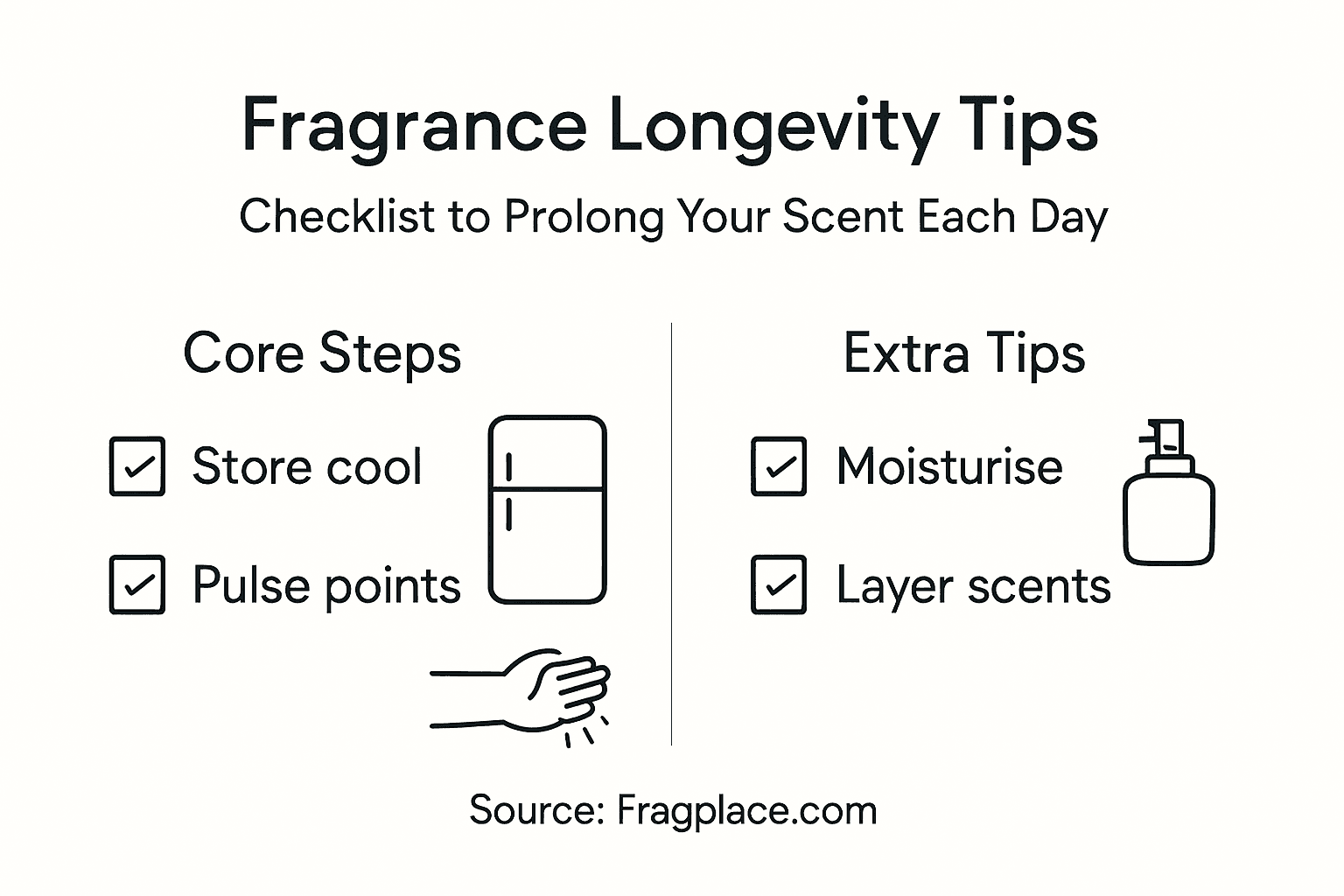
Placement does the heavy lifting. Pulse points — wrists, neck, inner elbows, behind the ears — generate heat that helps diffuse and amplify the scent, thanks to increased blood circulation and higher temperatures that activate and project fragrance molecules. Then there's the habit almost everyone has: rubbing your wrists together after spraying. It breaks down the delicate molecular structure and makes the scent dissipate faster. Stop doing it.
Layering is the technique that actually earns its reputation. Matching body products — shower gels, lotions, deodorants from the same line — build a deeper, longer-lasting foundation under the spray. If you'd rather not buy the whole line, an unscented moisturiser before the fragrance gives you a hydrated base that traps the aromatic compounds and releases them slowly. Dry skin is the enemy here, and it's the cheapest problem on this list to solve.
Pro Tip: Store your fragrances in a cool, dark place and apply to moisturised skin just after showering to maximise longevity and projection.
Skin chemistry is the reason a fragrance you loved on someone else can fall flat on you. Each person's biochemistry interacts with perfume molecules differently, which is why blind buys based on someone else's rave are a gamble.
The main variables are skin pH, moisture levels and natural oil production. Oily skin tends to hold fragrance longer because the molecules adhere better, while dry skin speeds up evaporation and cuts longevity. Hormonal shifts, diet, medication and stress levels all nudge skin chemistry around too, which is why a familiar bottle occasionally smells like a stranger.
Environment does its own work. Temperature, humidity and atmospheric pressure all affect projection and durability. Warmer climates intensify fragrance molecules, so you get faster diffusion but potentially shorter overall longevity — heat trades staying power for volume. Cooler air does the opposite, preserving and slowly releasing the aromatic compounds. Adjust your spray count by season rather than wondering why your summer signature reads faint in December.
Pro Tip: Keep a personal fragrance journal noting how weather and your own body chemistry interact with specific perfumes.
Most collections are undermined by habit, not by bad perfume. A few small errors are enough to shorten the life and quality of your favourites.
Storage is the big one. Direct sunlight, high temperatures and humidity degrade the molecular composition fast. Temperature fluctuations are particularly damaging, causing chemical breakdown and altering the perfume's original scent profile. Bathroom cabinets are the worst offender — the room heats up and cools down repeatedly all day, which accelerates degradation, reduces longevity and shifts the perfume away from what the perfumer intended. Windowsills are no better, however good the bottles look there.
Application is the other half. Rubbing fragrance into the skin breaks down the molecular structure, so you get faster evaporation and weaker projection. Piling incompatible fragrances on top of each other causes unpredictable chemical reactions that compromise the scent's integrity, leading to quicker dissipation and a muddled result. Layering works when the scents share a language; it doesn't work as a way to use up bottles you don't like.
Pro Tip: Keep your fragrances in a cool, dark cabinet away from direct light and temperature changes, and always spray rather than rub.
Good habits here are boring and they work. Storage, preparation and restraint matter more than any product you can buy.
Start with proper storage conditions. Keep bottles cool and dark, away from sunlight and temperature swings. A dedicated perfume cabinet or a closed dresser drawer works, where consistent temperatures between 16-22 degrees Celsius maintain the molecular integrity of the scent. Get them out of the bathroom, where humidity and temperature changes degrade the chemical composition quickly.
Application comes next. Moisturising before you spray creates a base that traps aromatic molecules and releases them slowly. Target pulse points — wrists, neck, behind the ears — where steady heat diffuses the fragrance through the day. Hold the bottle at a slight distance, spray, and let it settle on its own. Rubbing flattens the top, middle and base notes you paid for.
The table below summarises key factors for maximising fragrance longevity:
| Factor | Optimal Practice | Result |
|---|---|---|
| Skin Preparation | Apply unscented moisturiser | Slower fragrance evaporation |
| Application Location | Target pulse points | Enhanced diffusion and projection |
| Storage Conditions | Cool, dark, stable temperature | Preserved scent integrity |
| Application Technique | Spray, avoid rubbing | Fragrance structure maintained |
Pro Tip: A dedicated storage box with temperature and humidity control is worth it once your collection outgrows a drawer.
Here's the verdict. If you change one thing, change where your bottles live — a dark drawer at a steady 16-22 degrees Celsius protects every scent you own, and it costs nothing. If you change two, moisturise before you spray and quit rubbing your wrists. Concentration is the last lever to pull, not the first: buying up to Parfum won't rescue a fragrance you're storing in a hot bathroom and rubbing into dry skin.
So do two things. Read the scent breakdowns and reviews on Fragplace before your next blind buy, then bring your own longevity results to the community there — the fastest way to learn what performs is to compare notes with people wearing the same bottles.
Apply to well-moisturised skin, targeting pulse points such as the wrists and neck, and keep the bottle in a cool, dark place so the juice itself stays intact.
Concentration sets the range: Eau de Cologne lasts 2-3 hours, Eau de Toilette extends to 3-5 hours, Eau de Parfum lasts 5-8 hours, and Parfum can last 8-12 hours, depending on skin chemistry and environmental conditions.
Your pH, moisture levels and natural oils change both how long a fragrance lasts and how it smells, which is why the same perfume can read differently on two people.
Don't store bottles in direct sunlight or humid rooms, and don't rub the fragrance into your skin. Both break down the molecular structure of the scent and cut its longevity.