Articles
Get the Fragletter
New fragrance stories and picks in your inbox. Unsubscribe anytime.
New fragrance stories and picks in your inbox. Unsubscribe anytime.
New fragrance stories and picks in your inbox. Unsubscribe anytime.
New fragrance stories and picks in your inbox. Unsubscribe anytime.
Most fragrance reviews fail for a boring reason: "smells great, lasts ages" tells the next reader nothing. A fragrance evaluation checklist fixes that by making you answer the same questions in the same order every time, so a note you wrote in March still means something in November. The sharpest threads in the Fragplace community read like evidence rather than mood, and that's why.
The word "systematic" puts people off, and fair enough — nobody bought their first bottle hoping to fill in a form. But a checklist is only a promise to yourself that you'll judge the next perfume the way you judged the last one. That's the whole trick. It's also the difference between a review a stranger can act on and a paragraph of adjectives.
A working checklist covers a few distinct dimensions:
Keep that last one. Plenty of collectors strip emotion out to sound rigorous and end up describing a formula instead of a perfume. Professional practice doesn't work that way either: perfume formulation leans on sensory panels that analyse chemical composition and human perception at the same time, because neither answer is complete alone.
The following table summarises how different evaluation criteria contribute to a holistic fragrance assessment process:
Performance Parameters carry most of the practical load, because they're the part a reader uses to decide whether to spend:
Be honest about the third one. Molecular complexity gets asserted far more often than it gets assessed, and if you're taking it from a brand's copy, say so rather than passing it off as your own finding.
Pro tip: Score every parameter on the same numerical scale. Comparable beats clever.
Criteria are worth having only if you can apply them. Some of these you can judge yourself; others you're taking on trust from the house, and it's worth knowing which is which before you write a word.
A solid scent criteria framework covers:
Ethical sourcing sits oddly in a sensory list, and some collectors drop it for that reason. Don't. Provenance decides what actually goes into the bottle, and a house that won't talk about it has told you something.
A high price invites a harder look, so the parameters worth pressing on an expensive bottle are:
Performance consistency is the underrated entry. A fragrance that behaves one way on paper and another way an hour into the day isn't necessarily bad, but a review that mentions only the first ten minutes is.
Sensory Dynamics are where this gets genuinely hard. How molecules interact to produce something bigger than its note list takes technique and a trained nose, and no checklist substitutes for either.
Pro tip: Weight your criteria. If longevity matters more to you than provenance, say so in the scoring rather than pretending everything counts equally.
Sequence matters more than effort here. Sniff first, read the note pyramid later — do it the other way round and you'll find exactly what the brand told you to find.
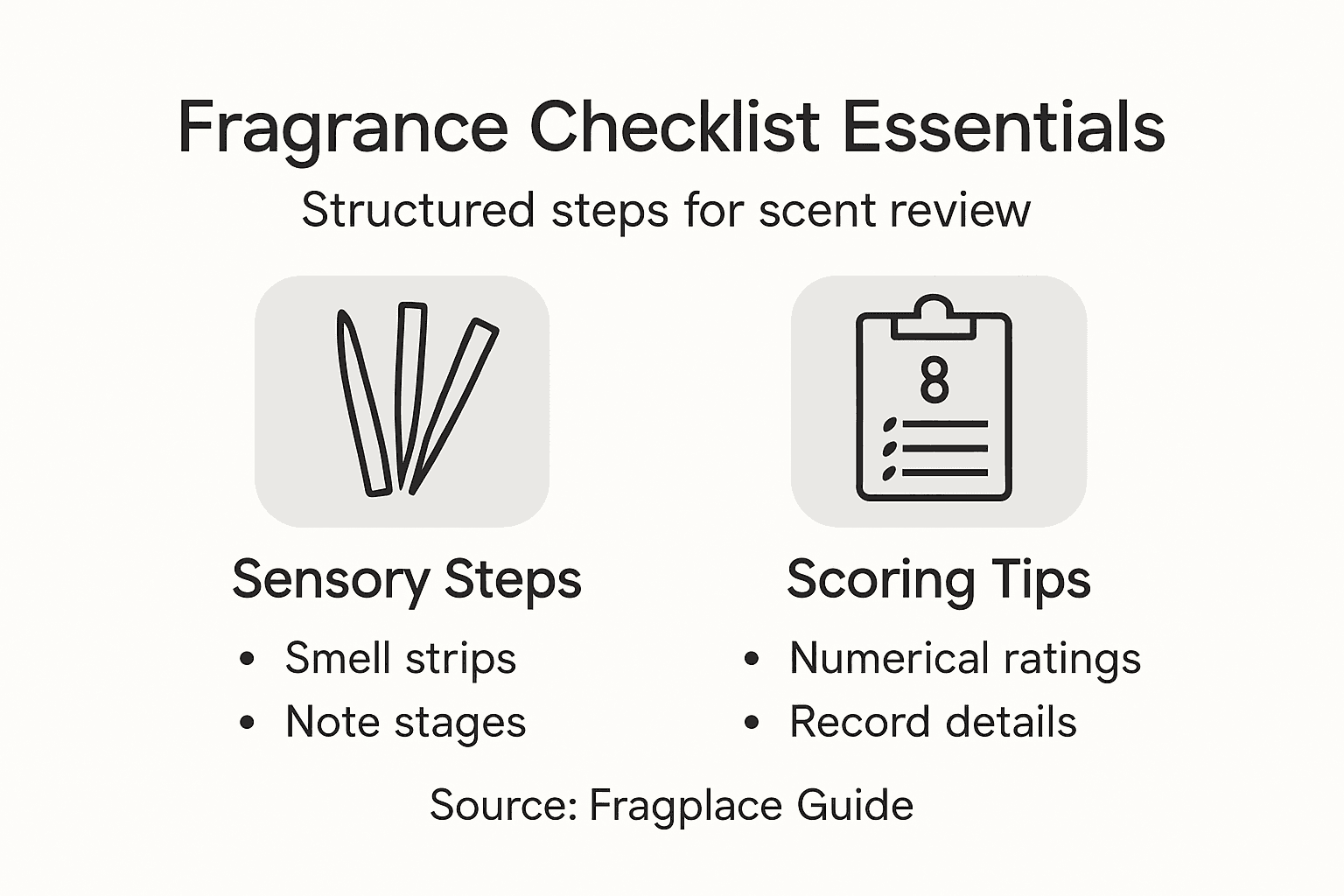
The process breaks into stages:
That last stage is the one most enthusiasts skip, and it's the one that produces the useful line: how this compares against the obvious rival at the same price. In practice, each stage comes down to five moves:
Olfactory Discrimination is the hardest part to build and the least discussed. Telling two similar ambers apart comes from repetition and deliberate training, not from owning more bottles.
Pro tip: Use one notebook with fixed sections per stage. A template you never change is worth more than a better template you use twice.
Most bad evaluations aren't careless — they're confidently wrong, which is worse. The errors below quietly undermine assessments that look thorough on the page.
The usual suspects:
Olfactory fatigue ruins more shop-counter verdicts than anything else on that list. By the fourth blotter you're guessing, and the fifth fragrance gets blamed for your nose giving up. Two sprays and a walk outside beat ten strips and a headache.
The fixes are unglamorous:
Sensory Complexity demands more than casual sniffing, but don't overcorrect into pseudo-science. Disciplined observation you actually repeat is worth more than a methodology you abandon after a fortnight.
Pro tip: Hold temperature, humidity and background odour steady across sessions. If your results aren't reproducible, they're anecdotes.
The usual framing says the professional method is the grown-up one. It isn't that simple — the two answer different questions, and mistaking one for the other is how people end up owning bottles they respect and never wear.
Where they part ways:
Here is a side-by-side comparison of personal and professional fragrance evaluation approaches:
| Approach Type | Primary Focus | Evaluation Method | Reliability of Results |
|---|---|---|---|
| Personal | Emotional impact | Casual, subjective | Variable, individual |
| Professional | Technical accuracy |
The professional toolkit is real work, and most of it sits outside what a collector can do at home:
Sensory Sophistication is what separates the serious collector from the enthusiastic one. Borrow the structure — the panel discipline, the metrics, the environmental control — but remember that the technical column never decides what you reach for on a Tuesday morning. Your emotional response does, and pretending otherwise makes for dishonest reviews.
Pro tip: Record both scores separately: one for how the fragrance performs, one for whether you'd wear it. Readers need both, and they aren't the same number.
If you take one thing from all this, take the fixed scoring sheet. Structure is what stops your reviews drifting with your mood, and it's the cheapest upgrade available to any collector — no new bottles required. Everything else here is refinement; that one habit is the whole return.
At Fragplace you'll find detailed fragrance notes, community reviews and the sort of discussion where projection, longevity and composition get argued over properly rather than asserted. It's built for people who want to compare their reading against someone else's instead of reviewing into a void.
So: build your scoring system, then go and use it in public. Read How to Write Fragrance Reviews Effectively to sharpen how you write it up, then post your first structured evaluation on Fragplace and see whether it holds up against the crowd.
It's a fixed set of questions you ask of every fragrance, in the same order, so your impressions turn into structured evaluations instead of scattered adjectives.
Because repeatability is what makes a review useful to anyone else. Precise, consistent sensory analysis lets you compare complex scents clearly — and lets a reader trust the comparison.
Initial impressions, the olfactory profile (top, middle and base notes), a complexity assessment, performance metrics such as longevity and sillage, and your emotional response to the fragrance.
Train your nose systematically, keep your testing environment controlled, and standardise your method so the results are comparable across sessions. Repetition does more here than any single clever technique.
| Point | Details |
|---|
| Structured Evaluation | A systematic fragrance evaluation checklist enhances objective assessments, ensuring consistent and meaningful insights. |
| Performance Metrics | Essential parameters such as longevity, projection, and molecular complexity provide critical insights into fragrance use and quality. |
| Sensory Dynamics | Understanding individual skin chemistry and emotional responses allows for personalised fragrance experiences while employing rigorous methodologies. |
| Avoiding Common Pitfalls | Recognising issues such as subjective bias and olfactory fatigue is vital for accurate fragrance evaluations, necessitating consistent application and environmental control. |
| Evaluation Criterion | Role in Assessment | Enhances Collector Insight |
|---|
| Olfactory Profile | Breaks down scent into note layers | Reveals complexity and blend quality |
| Performance Metrics | Measures longevity and projection | Predicts real-world use and value |
| Chemical Composition | Analyses molecular structure | Validates authenticity and uniqueness |
| Sensory Interaction | Assesses skin chemistry responses | Personalises each fragrance review |
| Systematic, structured |
| Consistent, replicable |