Articles
Get the Fragletter
New fragrance stories and picks in your inbox. Unsubscribe anytime.
New fragrance stories and picks in your inbox. Unsubscribe anytime.
New fragrance stories and picks in your inbox. Unsubscribe anytime.
New fragrance stories and picks in your inbox. Unsubscribe anytime.
Extrait de parfum is the concentration people romanticise most and interrogate least. Strip the marketing away and you're left with a straightforward trade: more perfume oil, slower release, a scent that unfolds instead of shouting once and leaving. It's a trade worth making, but not on every bottle and not for every wearer.
| Point | Details |
|---|---|
| Extrait de Parfum Definition | Extrait de parfum is the most concentrated fragrance type, containing 20-40% essential oils, making it more complex and long-lasting than lighter concentrations. |
| Application Technique | Only a small amount is needed for application; use a gentle dab on pulse points to enhance longevity and preserve molecular integrity. |
| Olfactory Development | Extrait de parfum evolves over time, revealing intricate layers of fragrance notes that interact uniquely with individual body chemistry. |
| Investment Consideration | While extrait de parfum can be expensive, its high quality and longevity make it a worthy investment for personal expression and luxury. |
Extrait de parfum, or pure perfume, sits at the top of the concentration ladder for one unglamorous reason: there's more fragrance oil in the bottle. The format comes out of French perfumery tradition and has never lost its prestige. Set beside an eau de toilette or an eau de cologne, extrait de parfum offers an intense sensory experience, and the higher percentage of essential oils is the whole explanation.
The numbers settle most arguments. Extrait typically carries between 20% and 40% pure fragrance oils, against 15% in eau de parfum and just 5-10% in eau de toilette. More oil means more room for detail, which is why a good extrait reads as nuanced rather than merely loud, and why it stays put. Perfumers build these formulas from their best material: rare botanical extracts, precious resins, aromatic compounds chosen one at a time. The production is labour-intensive, and harmonising something that dense takes genuine expertise. One caveat worth saying out loud, though: concentration isn't quality. A dull accord at 30% is a dull accord you can't get away from.
Application is where people go wrong. Extrait asks for a fraction of what you'd spray from a lighter concentration, usually a single drop on pulse points like the wrists, neck or behind the ears. From there it moves slowly, revealing layers of notes over several hours, and what you end up smelling depends on your body chemistry as much as on the formula. Treat it as punctuation, not paint.
Pro tip: When applying extrait de parfum, use the warmth of your fingertip to gently dab rather than rub, which helps preserve the fragrance's molecular integrity and prevents premature evaporation.
The concentration ladder isn't a quality ranking, whatever the pricing implies. Each rung is a different intention, from the featherweight eau de cologne to extrait de parfum. Fragrance enthusiasts explore diverse concentration types partly to work out which one suits the days they actually have.
Concentrations are usually categorised into five levels: eau de cologne (2-5% fragrance oils), eau de toilette (5-10%), eau de parfum (15-20%), parfum/extrait de parfum (20-40%) and pure parfum (40-50%). Those names aren't policed, so read the percentage rather than the word on the box. Eau de cologne gives you a light, refreshing burst for casual daytime wear. Eau de toilette adds a little more intensity and hangs around longer. Eau de parfum balances projection against subtlety, which is why it dominates evening events and professional settings.
What you choose depends on body chemistry, climate, occasion and taste. Extrait represents the pinnacle of the craft, and because you need fewer applications, a small bottle stretches further than the receipt suggests. Think about skin type, ambient temperature and how long you genuinely want to smell of something before you default to the strongest option on the shelf.
Pro tip: When sampling different fragrance concentrations, apply small amounts to your pulse points and allow at least 30 minutes for the scent to fully develop and interact with your unique body chemistry.
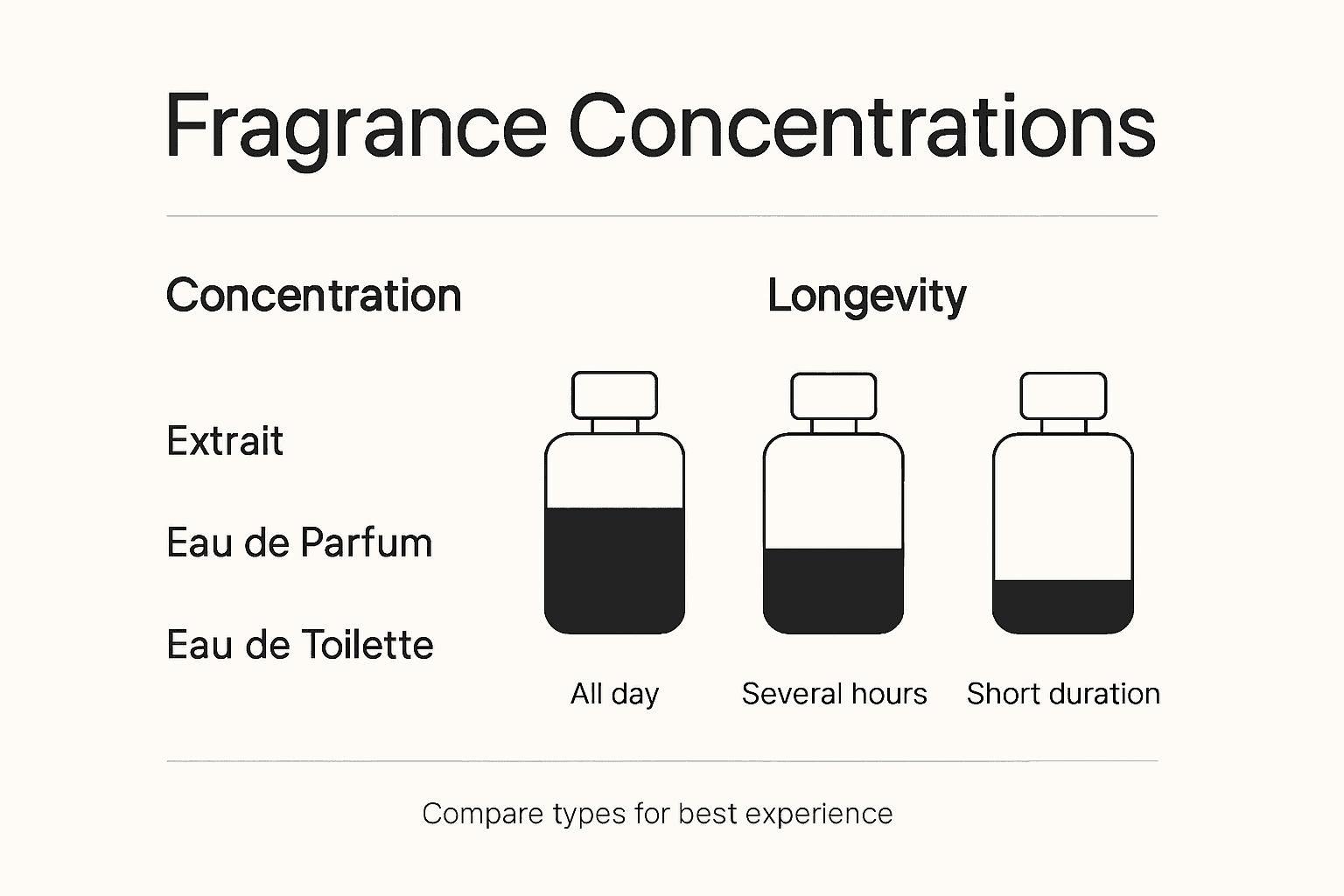
Here's how the main fragrance concentrations compare:
| Concentration Type | Typical Oil Content | Longevity on Skin | Sensory Experience |
|---|---|---|---|
| Eau de Cologne | 2-5% | 1-2 hours | Feather-light, refreshing |
| Eau de Toilette | 5-10% | 2-4 hours | Light, versatile |
| Eau de Parfum | 15-20% | 4-6 hours | Balanced, pronounced |
| Extrait de Parfum | 20-40% | 8-12 hours | Intense, complex, evolving |
| Pure Parfum | 40-50% | 12+ hours | Deep, luxurious, long-lasting |
Three things separate extrait from everything beneath it: sillage, longevity and olfactory development. Passionate fragrance communities explore these intricate nuances at length, and they're right to, because that trio is what the money buys. Sillage is French for 'wake' or 'trail'. It's the part of a perfume other people meet, the aura that carries past your own personal space.
Longevity is the least arguable advantage. The oil load lets an extrait sit on skin for 8 to 12 hours, sometimes stretching to a full day, because high-quality materials and slow-releasing molecular structures give up their aromatic compounds gradually rather than all at once. Top, heart and base notes arrive in sequence, so the perfume keeps saying something new for hours.
Development is the subtler pleasure, and the one worth chasing. Lighter concentrations often evaporate before they've finished the story; an extrait gives you the whole arc, from a vibrant opening through a heart that shifts over hours to base notes that reveal the composition's real character. Getting those transitions seamless is the hard part of perfumery, a balancing act between volatile and fixed materials. And if a fragrance smells identical at hour six to how it smelled at minute one, you've bought strength rather than artistry.
Pro tip: Store your extrait de parfum in a cool, dark place and apply to pulse points to maximise its complex olfactory development and preserve its intricate molecular structure.
Key factors affecting extrait de parfum performance:
| Factor | Impact on Experience | Practical Consideration |
|---|---|---|
| Skin Type | Alters scent longevity | Oily skin retains fragrance |
| Ambient Temperature | Influences fragrance projection | Warmer weather intensifies aroma |
| Application Location | Affects note development | Pulse points enhance evolution |
| Storage Conditions | Maintains molecular integrity | Cool, dark places preserve scent |
Buying extrait rewards patience and punishes impulse, which is the opposite of how most people shop for perfume. Fragrance enthusiasts explore nuanced application techniques for a practical reason: at this concentration, how you wear it changes the result as much as what you wear.
Start with the boring variables. Dry skin absorbs and dissipates fragrance quickly, while oily skin holds aromatic compounds and releases them slowly, so the same bottle behaves differently on different people. Season matters too: lighter, citrus-based extraits make sense in warm months, and richer compositions built on woody or resinous notes belong to cooler weather. Then be honest about your day. A perfume that's glorious at dinner can be an imposition in a small meeting room, and choosing one that suits your professional environment isn't a compromise, it's good manners.
Technique is just as important as choice. A single drop or a gentle dab on pulse points is the whole application: inner wrists, the base of the neck, behind the ear lobes, inside the elbows. Those spots are warm, and that body heat diffuses the fragrance and lets it interact with your chemistry as the hours pass. Don't rub. Rubbing breaks down the delicate aromatic compounds and scrambles the progression you paid for.
Pro tip: Layer your extrait de parfum with an unscented moisturiser to create a subtle base that helps the fragrance adhere more effectively and enhance its longevity.
Prices for extrait de parfum run from £100 to £1,000 and upwards, and the honest position is that the number tells you less than you'd like. Sometimes it reflects rare ingredients and painstaking production. Sometimes it reflects heavy glass, a designer name and a marketing budget. Learning to tell the two apart is the most valuable skill a collector can develop.
The usual mistakes are predictable. Buying blind because the bottle looked expensive. Treating concentration as a proxy for quality. Leaving the thing on a sunlit shelf in a warm bathroom. Newer collectors especially assume a higher price guarantees a better wear, when skin type, ambient temperature and personal biochemistry can change a fragrance's behaviour beyond recognition. Sample before you commit to a full bottle, every time.
Where extrait earns its keep is arithmetic. One drop per wear means a small bottle can last months or years, so the cost per wearing often undercuts a big eau de toilette you empty in a season. The concentrated formulation holds its structure and its staying power, and collectors treat the best examples as wearable art, valuing the craftsmanship and cultural weight along with the smell. That argument works, but only for a perfume you'll reach for. An unloved extrait is an expensive ornament.
Pro tip: Before purchasing an expensive extrait de parfum, always request a sample or testing strip to assess its performance over several hours and verify its compatibility with your unique body chemistry.
Comparing concentrations is more useful than ranking them. Fragrance communities explore these subtle variations in detail because each level does a job. Eau de cologne, the lightest, holds merely 2-5% fragrance oils and gives you a brisk 1-2 hours. Eau de toilette, at 5-10%, lasts longer and slots neatly into casual daytime wear.
Eau de parfum is the sensible middle at 15-20% fragrance oils and roughly 4-6 hours of performance, and for most people most of the time, it's the smarter purchase. Extrait de parfum, at 20-40%, is a different proposition. Lighter concentrations can fade before they've developed; extrait unfolds like a narrative, with layers that shift markedly across a wearing, and its molecular density means a single drop says more than repeated applications of something thinner.
Each concentration also demands a different approach. Eau de cologne suits hot days and quick refreshment. Eau de toilette handles professional environments without dominating them. Eau de parfum covers evenings. Extrait is the deliberate, intimate choice, the one you pick when the occasion deserves it, and it's a poor default for a stuffy office in July. Reserve it and it stays special; wear it everywhere and it becomes noise.
Pro tip: Consider building a fragrance wardrobe with multiple concentrations to match different occasions, understanding that each serves a unique sensory purpose.
Here's the verdict. Buy an extrait when you love the composition and want to hear all of it, and buy an eau de parfum when you want reach, flexibility and change. Concentration is a format, not a compliment: the people who get the most from extrait are the ones who sample slowly, apply sparingly and choose for the perfume rather than the percentage. If you're still learning how sillage and olfactory development behave on you, detailed perfume notes, perfumer insights and honest reviews from other wearers will get you further than any price tag.
First, join Fragplace.com and compare notes with people who've lived with the same bottles you're considering. Then read the Blog before your next full-bottle purchase, so the money goes on a perfume you'll finish rather than one you'll admire from a shelf.
Extrait de parfum, also known as pure perfume, is the most concentrated form of fragrance, containing between 20% and 40% pure fragrance oils. That gives it a more intense, longer-lasting character than lighter variants like eau de parfum or eau de toilette.
Use a single drop on pulse points such as the wrists or neck. The warmth there activates the fragrance and brings out its complexity without overwhelming anyone near you. Don't rub the application points, as that damages the fragrance's integrity.
Skin type, ambient temperature, application location and storage conditions all play a part. Oily skin retains fragrance better, warmer temperatures intensify the scent, and storing the bottle in a cool, dark place protects the perfume's molecular structure.
At 20-40% fragrance oils, extrait de parfum offers more complexity and longer wear (8-12 hours) than eau de parfum (15-20%, lasting 4-6 hours) or eau de toilette (5-10%, lasting 2-4 hours). Each concentration serves a distinct purpose, so the strongest isn't automatically the right one.