Articles
Get the Fragletter
New fragrance stories and picks in your inbox. Unsubscribe anytime.
New fragrance stories and picks in your inbox. Unsubscribe anytime.
New fragrance stories and picks in your inbox. Unsubscribe anytime.
New fragrance stories and picks in your inbox. Unsubscribe anytime.
Most people read "eau" on a bottle as decoration. It's a strength rating, and it's the most useful thing printed on the box. Eau de Parfum holds a concentration of 15-20% aromatic compounds, which puts it above the light sprays and below the extracts — and knowing where your bottle sits is the difference between buying well and buying twice.
Blame the French. "Eau" means water, so anything carrying the word sounds watered down, when what it actually marks is a concentration class. dermnetnz sorts perfume classifications by essential oil percentage and intensity, and that percentage is the part worth learning.
Eau de Parfum isn't a polite word for perfume in general. It's a bracket — typically 15-20% aromatic compounds — sitting above Eau de Toilette and below Parfum. That middle slot is why it gets recommended so often. More presence than the light stuff, less of a commitment than an extract.
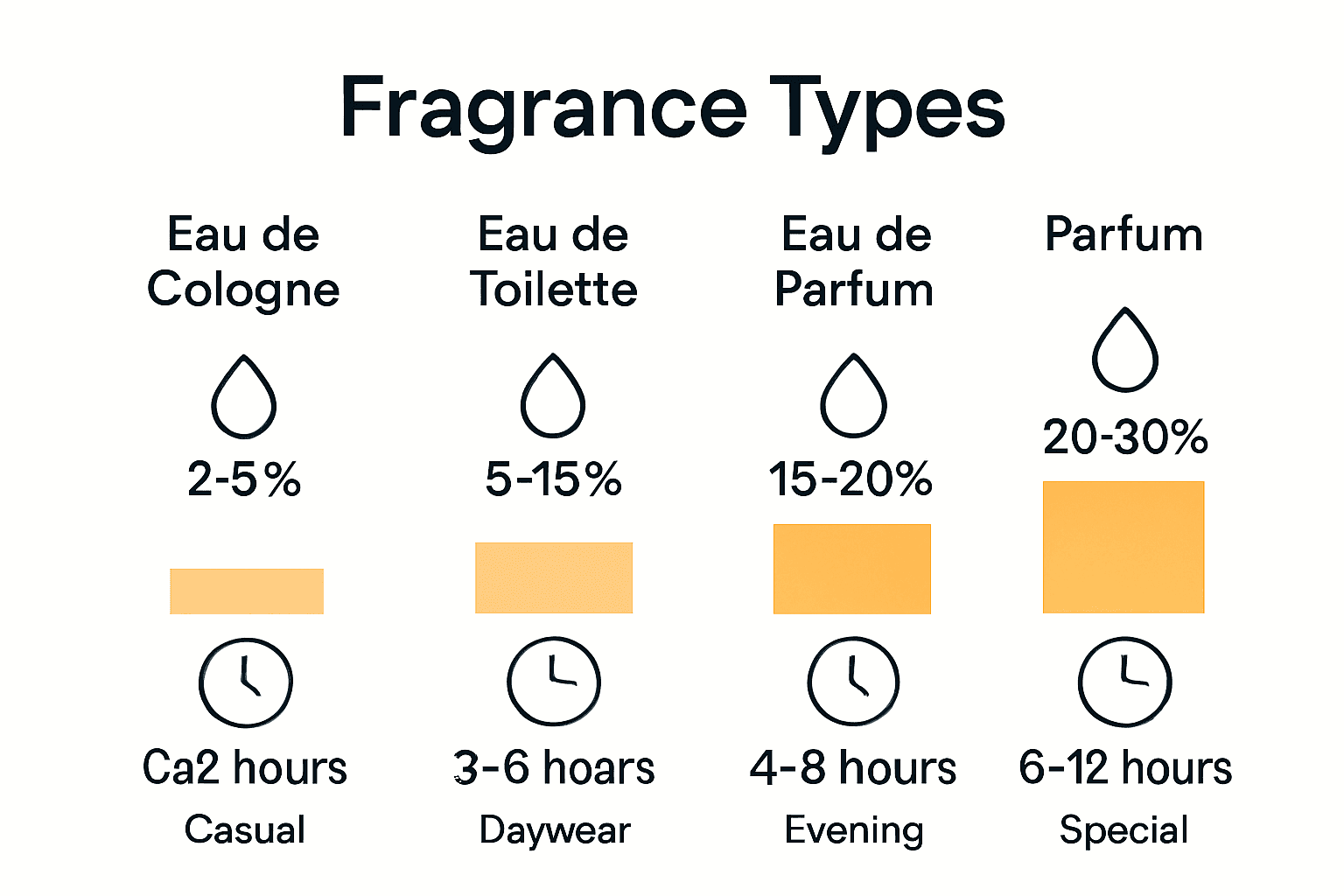
The misconception you'll hear most is that the four types are the same juice sold at four prices. They're not. Each one is built to do a different job:
Those percentages decide how long a scent stays, how far it travels off you, and how it behaves over an afternoon.
As the types of perfume classifications guide explains, the type on the label tells you how a bottle will behave before you've smelled a drop of it.
Price tracks concentration far more closely than it tracks quality, which is the first thing to hold in your head when you compare two bottles of the same scent. Research from ijcsrr ties these classifications to the percentage of essential oils, and that percentage drives intensity and staying power. ijcrt sets out the same ladder, lightest to heaviest:
If you buy one bottle a year, buy the Eau de Parfum. That 4-5 hour bracket covers a day at work or a long dinner without you thinking about it again. Cologne gets dismissed unfairly, mind you — at 2-4% it was never trying to last, and a bright 1-2 hour wash of scent in August is a pleasure rather than a failure. The extrait is the one people overspend on: 20-40% oils is a lot of fragrance to be wrong about, so know a scent properly before you commit to it at that strength.
For those looking to dive deeper into fragrance nuances, our guide on understanding fragrance layers offers an extensive exploration of how these different concentrations interact and impact overall scent experience.
Read the hour figures as brackets, not promises. Research from ijirt links the concentration of essential oils directly to a fragrance's strength and projection, which is the mechanism behind every number above.
The molecular composition of a perfume is what sets its longevity and its intensity. ou makes the related point that different concentration levels produce genuinely different sensory results — the strength doesn't just get turned up. Higher oil concentrations mean:
Broken down by level, the practical differences look like this:
Here's the caveat nobody selling you a bottle will offer: concentration is not quality. A well-built Eau de Toilette can read richer than a thin Eau de Parfum, because the percentage tells you how much material is in there, never how good the material is. Use it to predict behaviour, not beauty.
For fragrance enthusiasts looking to explore more nuanced insights, our blog on fragrance reviews offers additional perspectives on understanding and evaluating perfume characteristics.
Where you spray matters nearly as much as what you spray. According to dermnetnz, strategic application techniques can meaningfully change how a fragrance performs and how long it lasts, whatever the concentration.
Pulse point application is the method to default to. These warm areas of the body - including the wrists, neck, behind the ears, inside the elbows, and behind the knees - naturally diffuse heat, helping to activate and project the scent. Each eau perfume type wants a slightly different hand:
The pattern is simple enough: the stronger the concentration, the lighter your hand. Most people who complain that an Eau de Parfum gives them a headache are wearing three or four sprays of something designed for one or two.
Storage is the other half of it, and it's where good bottles quietly die. Keep your perfumes away from direct sunlight, extreme temperatures, and humidity to preserve their molecular integrity and prevent degradation. The bathroom shelf is the worst place in your home for a fragrance, and it's where nearly everyone keeps theirs.
If you want more on getting the most out of what you own, the fragrance reviews blog linked above is the place to go next.
Side by side, the differences stop being abstract. Research from ijcsrr places Eau de Parfum in its own category with attributes that separate it from the classifications either side of it.
Molecular composition and concentration are the root of every difference. ijcrt highlights the distinctions that actually change how a bottle performs on you:
Concentration Comparison:
Eau de Cologne: 2-4% aromatic compounds
Eau de Toilette: 5-15% aromatic compounds
Eau de Parfum: 15-20% aromatic compounds
Pure Perfume/Extrait: 20-40% aromatic compounds
Note how wide the Eau de Toilette band is — 5% and 15% are not the same fragrance, and both are allowed to wear the same three words. That's why one EDT vanishes by lunch and another outlasts a friend's Eau de Parfum. The label is a range, not a spec.
Eau de Parfum earns its popularity by sitting in the useful middle: deeper than the lighter versions, easier to live with than an extract. It's the safest bottle to buy blind, and the one most likely to still get worn a year later.
For fragrance enthusiasts interested in exploring the diverse world of scents, our blog collection offers comprehensive insights into the intricate universe of perfumery.
The verdict: buy the Eau de Parfum. At 15-20% it's the concentration that does the most jobs adequately and the fewest badly, and 1-2 sprays of it will see you through an evening. Buy an Eau de Toilette instead if you work in close quarters or live somewhere hot, where 2-3 sprays of something lighter is the kinder choice. Buy the extrait only when you already know a scent well enough to want six hours of it. And if you like the ritual of topping up, cologne is not a lesser purchase — it's a different habit.
Two things to do next. Read the rest of our blog collection to work out which concentration suits how you actually live. Then join the fragrance lovers on Fragplace, where honest reviews and a community that argues about this stuff will get you to a personalised shortlist faster than any shop assistant will.
"Eau" is French for water, and on a bottle it flags a concentration category — each one carrying a different percentage of aromatic compounds.
Strength and stamina. Eau de Parfum typically holds 15-20% aromatic compounds and lasts 4-5 hours; Eau de Toilette holds 5-15% and lasts 2-3, which makes it the lighter, more casual of the two.
Go for pulse points — wrists, neck, behind the ears — and stop at 1-2 sprays. That's plenty for an evening, and more is usually where people go wrong.
The more oil, the longer and louder. Parfum at 20-40% runs 6-8 hours or more with real intensity, while Eau de Cologne at 2-4% gives you freshness and 1-2 hours before it's gone.
| Type of Fragrance | Details |
|---|
| Concentration Levels Matter | Fragrance types vary based on the percentage of essential oils, influencing their strength, projection, and longevity. |
| Eau de Parfum Unique Standing | Eau de Parfum, with 15-20% aromatic compounds, offers a balance between wearability and intensity, making it ideal for various occasions. |
| Application Techniques Enhance Experience | Strategic application at pulse points can maximize a fragrance's potential and longevity across different types. |
| Storage Affects Quality | Proper storage away from sunlight and humidity is essential to maintain the integrity and performance of perfumes. |