Articles
Get the Fragletter
New fragrance stories and picks in your inbox. Unsubscribe anytime.
New fragrance stories and picks in your inbox. Unsubscribe anytime.
New fragrance stories and picks in your inbox. Unsubscribe anytime.
New fragrance stories and picks in your inbox. Unsubscribe anytime.
The French on the bottle is doing more work for the marketing department than for you, which is probably why over 80 percent of British fragrance shoppers admit confusion when choosing between Eau de Toilette, Eau de Parfum, and Parfum. All three labels tell you one thing: roughly how much perfume oil is in the juice. Everything else people claim about them follows from that single number.
Strip away the French and you're left with a percentage. Parfum is the heaviest pour, typically 20-40% pure fragrance oils, which is why two dabs hold for 6-8 hours and why anything more than that is money evaporating off your neck. Eau de Parfum sits in the middle at roughly 15-20% perfume oils and runs 4-5 hours, which is the range most people actually need.
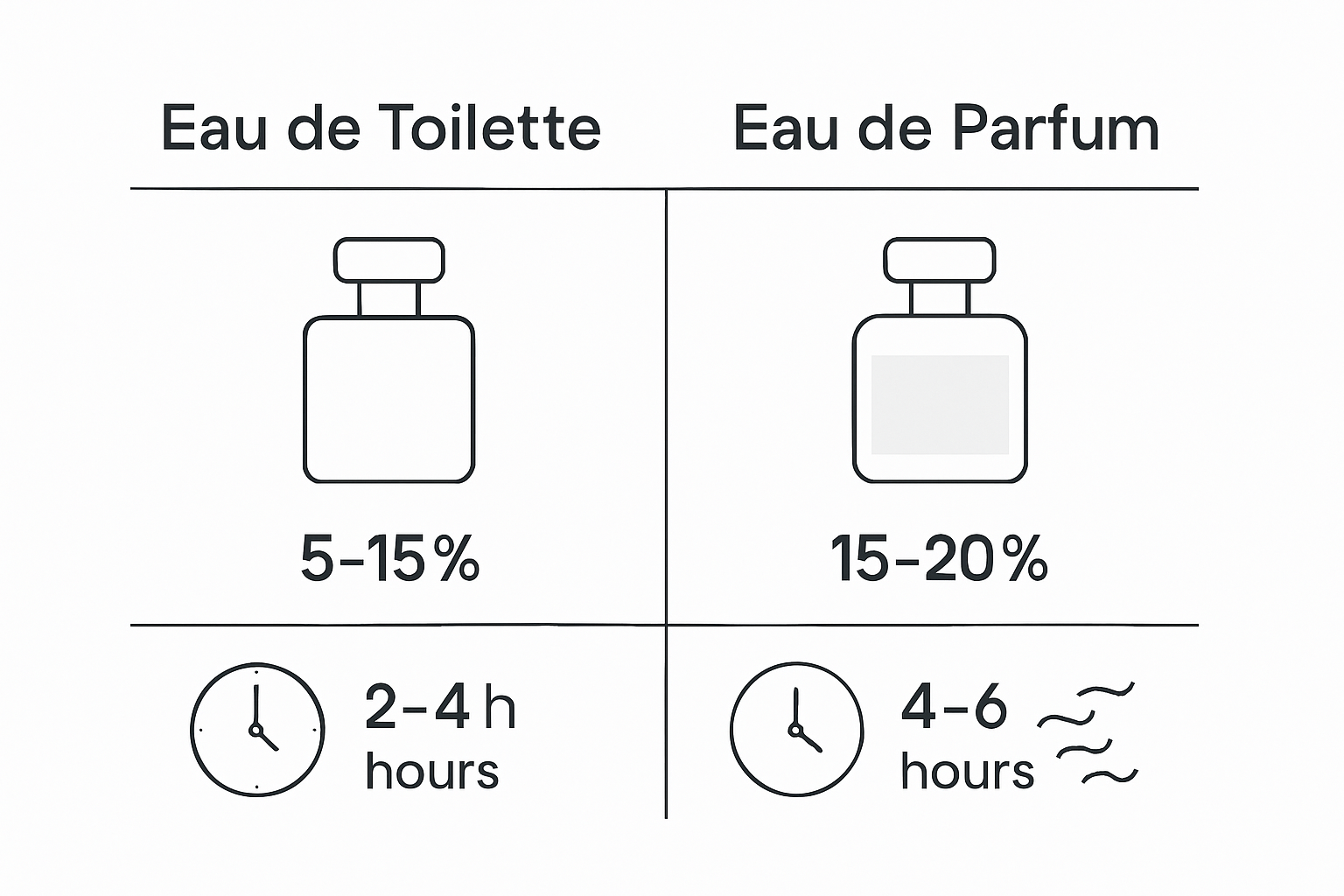
Eau de Toilette is the thinnest of the three, 5-15% perfume oils, present for around 2-3 hours before it settles into your collar. That's not a defect. A lighter concentration is the honest choice for heat, shared desks and anyone who'd rather be noticed at conversational distance than across a room. These tiers grew out of traditional perfumery practice rather than any regulator's rulebook, so read them as a strength setting, not a quality grade.
Which is the part the labels never admit: an EDT of a brilliant composition beats an EDP of a dull one. Concentration tells you how loud a fragrance is. It tells you nothing about whether it's worth smelling.
Oil percentage is the biggest single lever on how long a scent stays perceptible — more oil, more hours. Parfum, with the highest concentration of fragrance oils, can persist up to 8-10 hours, which is why it belongs to evenings and occasions rather than Tuesdays. Eau de Parfum typically maintains its presence for 4-6 hours, enough to cover the working day if you spray before you leave the house.
Eau de Toilette generally lasts 2-4 hours. Plan around that instead of resenting it: keep a decant in your bag and re-apply after lunch, and a light concentration stops being a compromise.
Concentration isn't the whole story, though. Skin type, humidity, temperature and how you apply it all move the number, and molecular composition matters too — bright citrus and aromatic materials burn off fast whatever percentage they're suspended in, while heavier bases cling. Notice how the quoted hour ranges shift depending on who's quoting them. That drift is the honest signal here: these figures are averages, not a warranty.
So pick the concentration that matches how your day is actually shaped, not the one with the biggest number on the box.
Sillage is the French term for the trail a fragrance leaves behind you, and it's where the gap between concentrations gets obvious. Eau de Parfum pushes a more pronounced and persistent aroma than Eau de Toilette. Parfum, the most concentrated form, projects hard enough to fill a room, while Eau de Toilette keeps a lighter, more contained presence that suits professional or daytime settings.
Big sillage is a preference, not an upgrade. A fragrance that fills a room fills the lift too, and plenty of people who chase projection end up wearing something their colleagues quietly dread.
Price follows concentration closely. Parfum sits at the top, typically £100-£500, thanks to its high essential oil content and labour-intensive production. Eau de Parfum occupies the mid-range at £50-£200. Eau de Toilette is the cheapest way in at £30-£100, which makes it the sensible format for experimenting with a house you don't know yet.
The returns flatten fast above the middle tier. Doubling your spend from Eau de Parfum to Parfum doesn't double anything you'll notice on an ordinary day — you're buying a few extra hours and a heavier opening, and you'll use the bottle a fraction as often.
Match the concentration to the room you'll be standing in. That's the whole rule, and it's simpler than the guides make it sound.
Eau de Toilette earns its place in daytime and professional settings where restraint is the point. Its lighter concentration keeps you present without imposing on colleagues or a casual lunch table, which makes it the right pick for office wear, morning meetings, brunch and warm weather.
Eau de Parfum covers the middle ground: evening social events, dinner dates, networking functions, anything that starts at six and runs late. The stronger projection and longer wear mean you're still wearing it at the end of the night rather than the memory of it. If you only own one bottle, own this one.
Parfum is for the handful of occasions that justify it — formal events, gala evenings, romantic dinners, winter gatherings where coats and heat and heavy fabrics swallow lighter things. Its intensity means minimal application, so treat it as a luxury you reach for deliberately.
Hold these loosely, though. An Eau de Toilette in winter isn't a mistake if you like it and don't mind topping up, and a discreet Eau de Parfum applied with one spray is perfectly office-appropriate. Occasion charts describe averages; you're not one.
Most bad bottles are bought in the first five minutes of smelling something. Here's what goes wrong.
Sampling misconceptions cause the bulk of the damage. Spraying a wrist at the counter and buying on the spot ignores skin chemistry, scent evolution and the way a composition transforms over several hours. Wear a sample for a full day before you commit, and watch how the notes develop. The opening is a sales pitch. The dry-down is what you actually own.
The second mistake is buying for a life you don't lead. A high-concentration Parfum bought for everyday wear, or an Eau de Toilette taken to a formal evening, is a mismatch between format and context: Eau de Toilette suits professional environments, Eau de Parfum works for evening social interactions, and Parfum is reserved for special occasions. Be honest about which of those your calendar is mostly made of.
Then there's the maths. Judging a bottle on its sticker price alone ignores concentration, longevity and how many sprays you'll burn through each morning. A pricier Eau de Parfum can work out cheaper than replacing multiple bottles of Eau de Toilette, because a higher oil concentration means less product per wear. Work out the cost per day, not the cost per bottle.
The verdict: for most people, most days, buy the Eau de Parfum. Its 4-6 hours and mid-range price cover the widest slice of real life, and it's the format that flatters the greatest number of compositions. Choose Eau de Toilette when it's hot, when you're in close quarters all day, or when you want to try an unfamiliar house without spending £200 to find out. Save Parfum for a scent you already know you love — at £100-£500 it's a loyalty purchase, not an experiment.
The quickest way to dodge a bad bottle is to read what people say about how a fragrance behaves hours in, not seconds in. Start with the scent profiles and honest reviews on Fragplace to see which concentration of a scent people actually reach for. Then post your shortlist to the community of fragrance passionates and let the people who own both formats tell you which one is worth your money.
Oil content, and everything that follows from it. Eau de Toilette holds 5-15% perfume oils for a lighter scent lasting 2-4 hours; Eau de Parfum carries 15-20% perfume oils, giving a more intense aroma that runs 4-6 hours.
Roughly 2-4 hours for Eau de Toilette and around 4-6 hours for Eau de Parfum, thanks to the higher concentration of fragrance oils in the latter. Treat those as averages — heat, skin and application all shift them.
When the room is warm or the company is close. Eau de Toilette is the better call for daytime wear, professional environments and casual outings where a lighter scent is preferred — warm weather, morning meetings, brunch.
Yes, and it's the format most people should default to. It balances subtlety against lasting power, so it holds up through evening events and social gatherings without dominating the room. One spray fewer is all it takes to make it work at the office.
| Point | Details |
|---|
| Fragrance Classifications | Eau de Toilette, Eau de Parfum, and Parfum differ primarily in fragrance oil concentrations, influencing scent intensity and longevity. |
| Longevity and Use | Parfum lasts 6-10 hours, Eau de Parfum 4-6 hours, and Eau de Toilette 2-4 hours, guiding choices based on occasion and desired impact. |
| Sillage and Pricing | Sillage varies between concentrations; Parfum is the most expensive, while Eau de Toilette is more budget-friendly. |
| Common Purchasing Mistakes | Avoid testing fragrances incorrectly; instead, sample them properly to understand their evolution on your skin before purchasing. |