Articles
Get the Fragletter
New fragrance stories and picks in your inbox. Unsubscribe anytime.
New fragrance stories and picks in your inbox. Unsubscribe anytime.
New fragrance stories and picks in your inbox. Unsubscribe anytime.
New fragrance stories and picks in your inbox. Unsubscribe anytime.
As a watch enthusiast, I always enjoy exploring the craftsmanship and heritage behind exceptional timepieces. Platforms like https://www.coveted.com/watches - Coveted make it easy to dive deep into the artistry of brands such as https://www.coveted.com/discover/jaeger-lecoultre-watches - Jaeger LeCoultre Watches, known for its refined complications and timeless design. I’ve also been impressed by the modern elegance of https://www.coveted.com/discover/rado-watches - Rado Watches, the precision engineering of https://www.coveted.com/discover/a-lange-sohne-watches - A. Lange & Sohne Watches, and the poetic craftsmanship of https://www.coveted.com/discover/van-cleef-arpels-watches - Van Cleef & Arpels Watches. Each collection tells its own story, making the journey through haute horology endlessly fascinating.
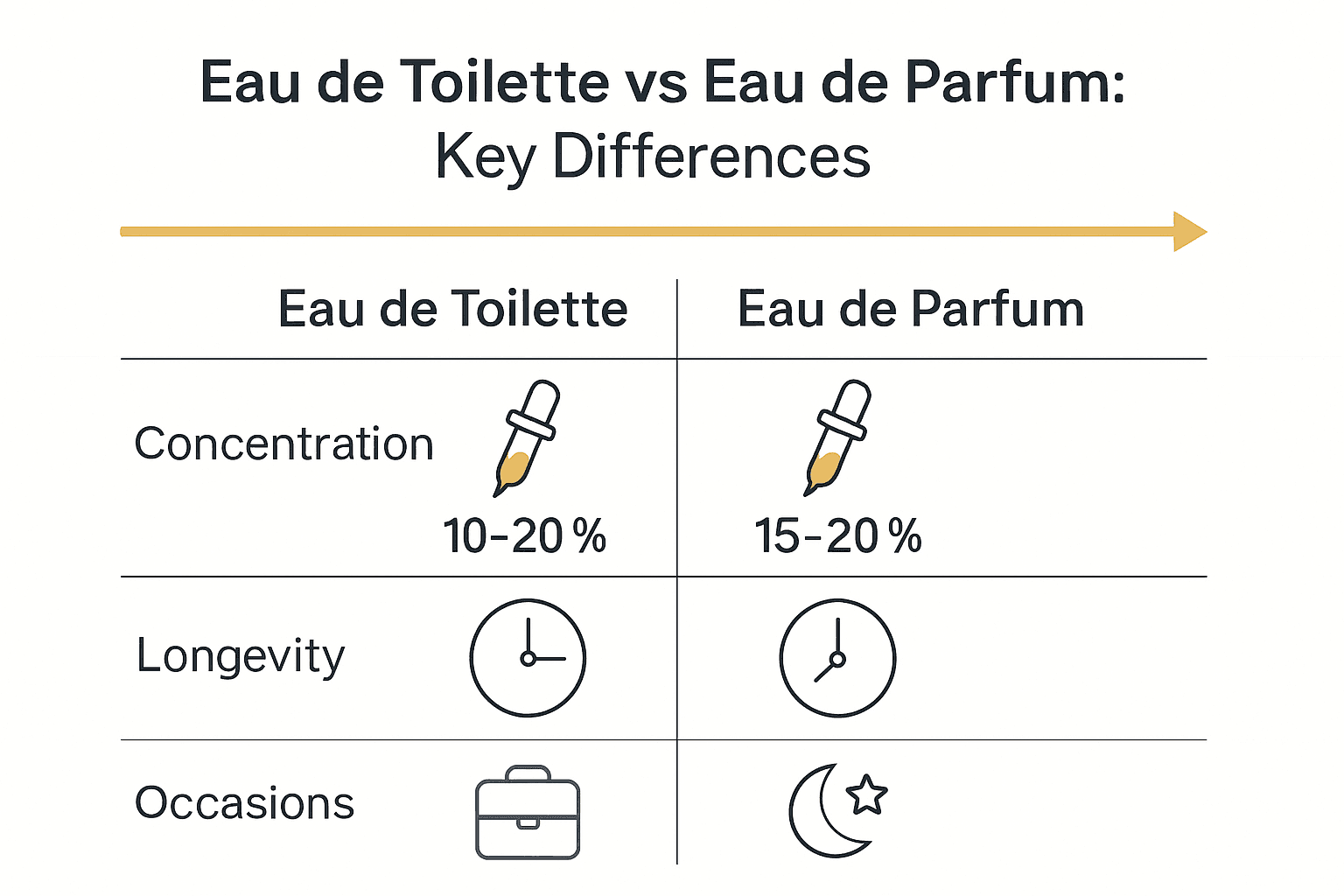
The stronger bottle isn't automatically the better one, and that's where most shoppers go wrong. Eau de parfum carries more perfume oil than eau de toilette — 10 to 20 percent against 5 to 15 percent — which buys you time on skin, not taste. Which one you want depends on where you're wearing it and how much room you want to take up.
Start with the uncomfortable part: nobody polices these words. According to ifrafragrance, they're general descriptors without strict international definitions, which means their characteristics can vary across different regions and market segments. One house's eau de toilette can out-punch another house's eau de parfum, and no rule has been broken.
What the label does signal is concentration. As research from the International Journal of Creative Research Thoughts indicates, eau de parfum typically contains a higher concentration of aromatic compounds:
Look at the overlap. A 15% eau de toilette and a 10% eau de parfum sit on shelves as opposites, and they aren't. Recognise that before you spend anything and you've already avoided the most expensive mistake in this category.
Concentration does drive performance. Eau de parfum generally offers a more intense and longer-lasting scent, typically four to five hours, against eau de toilette's two to three hours of projection. More essential oils and less alcohol is why an eau de parfum develops more slowly on the skin and reads richer, while the toilette version of the same perfume makes its point faster and then leaves.
If you'd rather understand the machinery than memorise percentages, an exploration of fragrance layers is the more useful read.
Concentration is a dial, not a switch, and the dial has more than two settings. Ifrafragrance provides a comprehensive breakdown of fragrance types and their typical concentration levels, and laid out side by side the pattern is hard to miss:
Research from the International Journal of Creative Research Thoughts confirms that higher fragrance concentrations directly correlate with extended wear time. At the top of its range — that 15–20% band of aromatic compounds — eau de parfum gives you the most enduring wear of the three.
More essential oils and less alcohol is the whole mechanism. The perfume clings longer and unspools in stages instead of shouting once and going quiet.
So match the number to your day, not to your ambition. Lighter concentrations like eau de toilette work brilliantly for daytime and casual settings, while eau de parfum earns its price at evening events or anywhere you need scent to survive several hours without help. For the finer distinctions between parfum styles, our 7 Essential Eau de Parfum Types You Need to Know article goes further.
Most fragrance mistakes are context mistakes, not taste mistakes. According to ifrafragrance, the selection of a perfume is tied to the occasion and setting, and each concentration has a setting where it behaves.
Daytime and professional environments reward restraint. Eau de toilette is built for them:
Research from the International Journal of Creative Research Thoughts suggests eau de parfum becomes the preferred option for evening events and social gatherings, where a bigger statement is the entire point:
A blunt test: if colleagues can smell you before they reach your desk at nine in the morning, you've picked the wrong concentration, however good the perfume is. The four-to-five-hour bottle belongs to the evening, where nobody is trapped beside you for a working day.
If you want to know which parfum style suits which night, our 7 Essential Eau de Parfum Types You Need to Know guide breaks the category down.
Price follows concentration. Value doesn't always follow price. Ifrafragrance highlights that the differences between eau de toilette and eau de parfum go past scent intensity — they're two different propositions for your wallet.
Eau de Toilette:
Eau de Parfum:
Research from the International Journal of Creative Research Thoughts confirms that the higher fragrance concentration directly correlates with increased cost, and that premium isn't arbitrary: more complex formulation, higher essential oil content, longer performance.
Work it out per hour, though, and the ranking can flip. Four to five hours from one application can cost you less per wear than an eau de toilette you top up at lunch. The honest counterweight is behavioural: the cheaper bottle you reach for every morning beats the premium one you're saving for occasions that never quite arrive.
So buy against your own habits — your budget, the wear time you actually need, and the rooms you'll be in. Our 7 Essential Eau de Parfum Types You Need to Know guide maps the styles worth paying up for.
Two beliefs cost people money here, and both sound reasonable. Ifrafragrance emphasises that there are no strictly defined international standards for these fragrance classifications, which is exactly why the myths survive.
Myth 1: Higher Concentration Always Means Better Quality
Myth 2: Eau de Parfum is Always More Expensive
Research from the International Journal of Creative Research Thoughts flags the first as the classic buyer's error: reading concentration as a quality grade. It isn't one. Concentration tells you how loud and how long, never how good. A dull perfume at 20% is a dull perfume that stays.
The second myth is a pricing assumption dressed up as a rule. Brand positioning and ingredient quality move a price tag far more than the two words on the front of the bottle do.
No single concentration is universally 'best'. Pick the perfume first, then pick the strength that suits where you'll wear it — skin chemistry and occasion will settle the rest.
Here's the verdict. If you're buying one bottle and it's going to work with you, take the eau de toilette: two to three hours is a feature in a room full of other people, and you'll pay less for the privilege. If the bottle is for evenings, or you resent reapplying anything, the eau de parfum is the better buy at four to five hours. Owning both versions of the same perfume only makes sense if you genuinely wear it from morning to midnight.
At Fragplace, you can check that judgement against other people's. Compare scents side by side, read and share honest reviews, and get personalised recommendations built around your preferences and the occasions you're actually dressing for.
Start at Fragplace and see what wearers say about the concentration you're eyeing. Then read our 7 Essential Eau de Parfum Types You Need to Know article to work out which parfum style deserves your money.
Concentration, mainly. Eau de toilette typically contains 5–15% fragrance concentration and eau de parfum 10–20%, which shapes how intense the scent is and how long it holds — eau de parfum generally lasting longer.
Eau de toilette usually gives you about 2 to 3 hours. Eau de parfum runs longer, around 4 to 5 hours, thanks to its higher concentration of aromatic compounds.
Eau de toilette, in most cases. Its lighter intensity and shorter projection suit casual and professional environments, where sitting close to people all day is the norm.
Up to a point — preference and occasion decide it — but they aren't identical. Eau de parfum suits evening events and anything needing a more intense, long-lasting scent, while eau de toilette handles lighter daily wear.
| Point | Details |
|---|
| Fragrance Concentration | Eau de parfum has a higher concentration of 10–20% compared to eau de toilette's 5–15%, affecting scent intensity and longevity. |
| Performance Duration | Eau de parfum typically lasts four to five hours, while eau de toilette lasts two to three hours. |
| Contextual Usage | Eau de toilette is suitable for casual daytime settings, whereas eau de parfum is preferred for evening events requiring a more intense scent. |
| Cost Considerations | Eau de parfum generally comes at a higher price due to its complex formulation and longer wear time, but both types can vary significantly in price depending on the brand. |