Articles
Get the Fragletter
New fragrance stories and picks in your inbox. Unsubscribe anytime.
New fragrance stories and picks in your inbox. Unsubscribe anytime.
New fragrance stories and picks in your inbox. Unsubscribe anytime.
New fragrance stories and picks in your inbox. Unsubscribe anytime.
Stronger isn't better. It's just stronger. Over 60 percent of British perfume shoppers can't confidently explain the difference between Eau de Parfum and Eau de Toilette, and that gap is exactly why so many people end up with the wrong bottle of a scent they already liked.
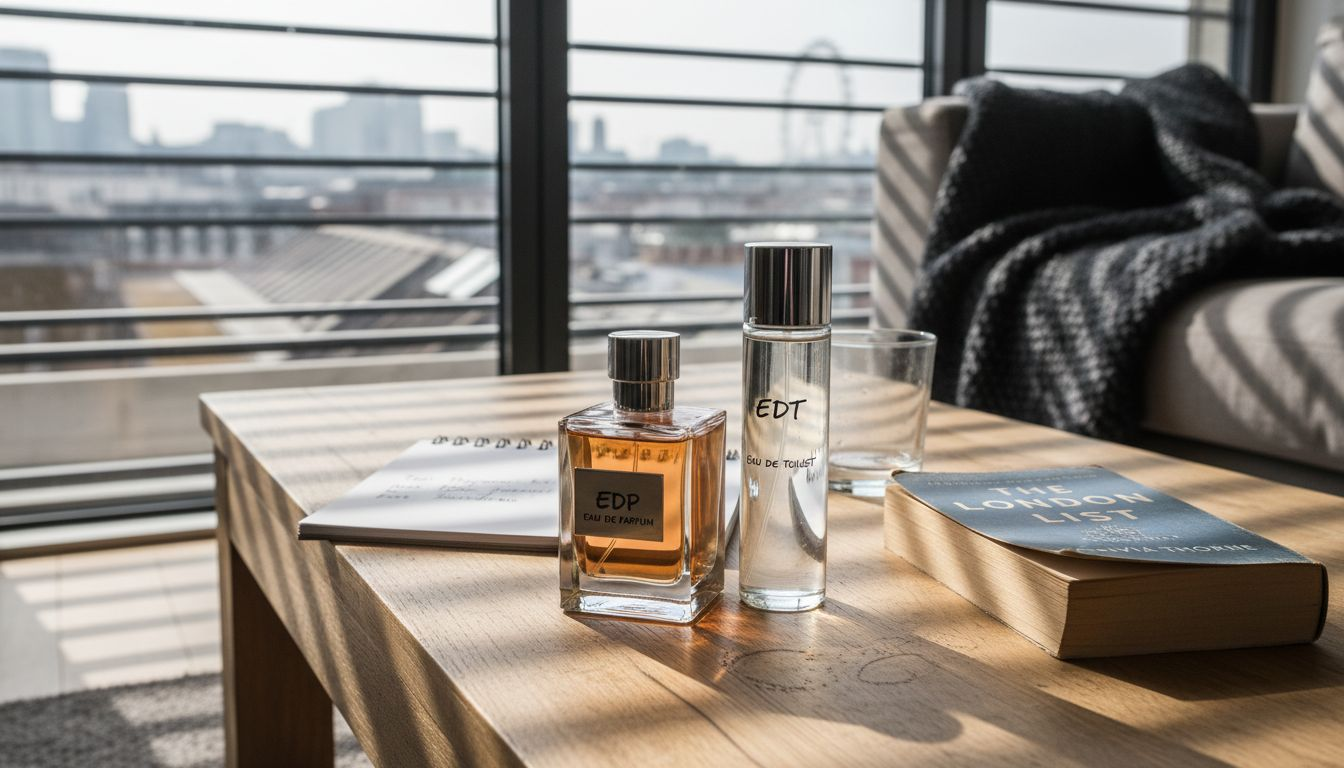
Most of the time you're looking at the same perfume sold at two strengths, and the label is telling you how much fragrance oil is in the bottle. That's the whole secret. Everything else follows from it.
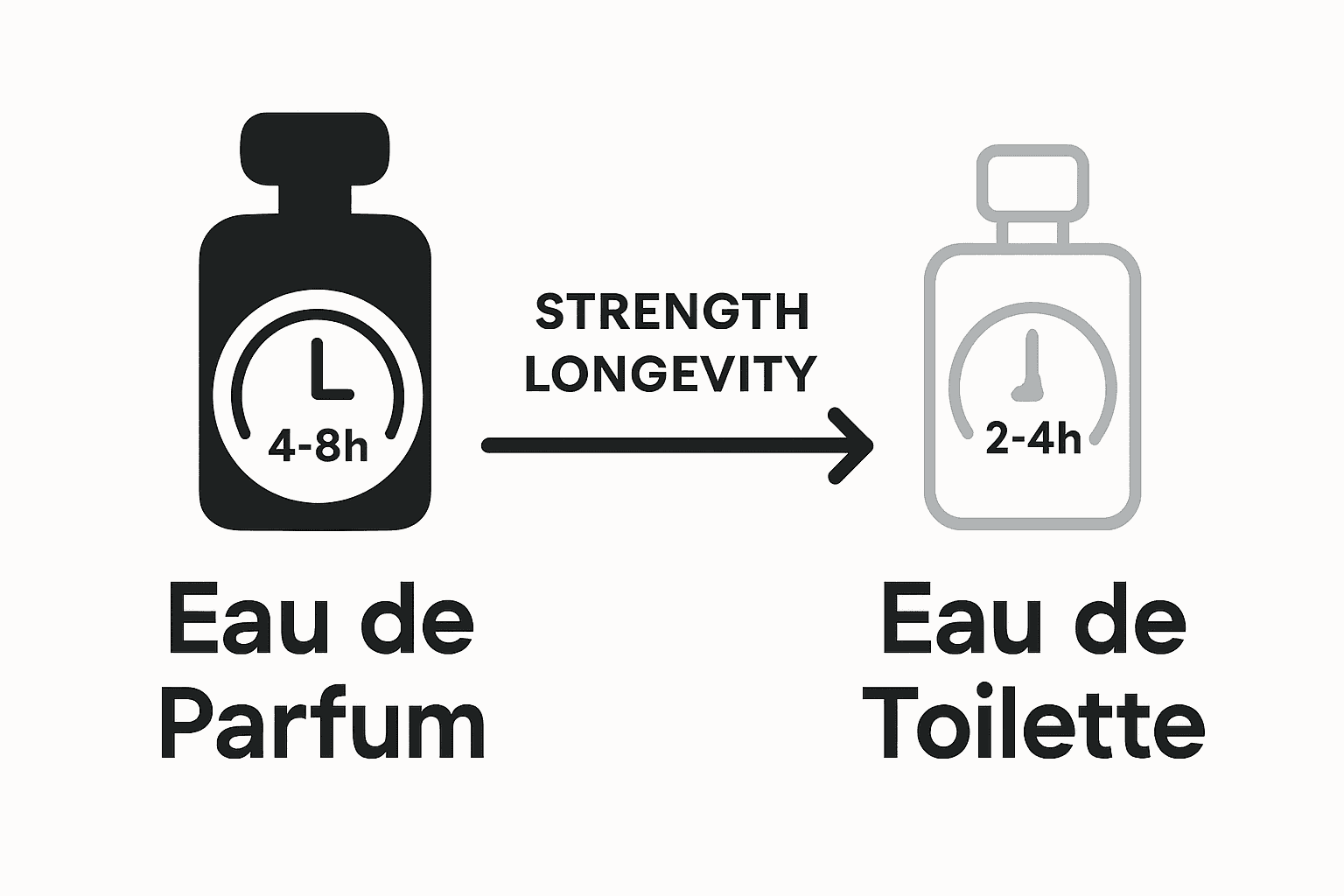
Eau de Parfum (EDP) sits at roughly 15% to 20% pure fragrance oils. More oil means the scent stays put and keeps developing rather than flashing off, which is why an EDP tends to hold for 4 to 8 hours and reads deeper as the day goes on.
Eau de Toilette (EDT) runs leaner, between 5% and 15%. You get a lighter reading of the same idea, and around 2 to 4 hours of it. That's a fair trade if you want your perfume close to the skin. It's a genuine annoyance if you're out all day and can't be bothered to carry a decant.
Pro Tip: Fragrance Selection Strategy: Before you pick a concentration, think about where you'll actually be wearing it, how many hours you need it to hold, and how loud you want to be while you're there.
Here's how the two compare at a glance:
Concentration and sillage get discussed as if they're the same thing. They're related, not identical, and the distinction is worth holding onto.
Concentration is simply the proportion of pure fragrance oils in the formula. At the 15% to 20% of an Eau de Parfum, the notes unfold slowly instead of arriving all at once, and the composition keeps its shape for hours rather than collapsing into a vague sweetness by lunchtime.
Sillage comes from the French for 'wake' or 'trail', and it describes what other people notice. An Eau de Toilette at 5% to 15% keeps that trail short. Some wearers read that as weak. It's better understood as considerate: in an open-plan office or a small meeting room, a modest sillage is the more socially intelligent choice.
Pro Tip Sillage Selection: Think about the size of the room before the strength of the scent. Heavier concentrations earn their keep at evening events, while lighter ones are kinder across a desk.
Longevity is how long a fragrance lasts on you. Projection is how far it travels off you. Confuse the two and you'll blame the wrong thing when a bottle disappoints you.
Eau de Parfum wins on longevity, holding for 4 to 8 hours, because there's simply more oil to work through. The pay-off isn't only duration. Top, middle and base notes get the time to hand over to each other properly, so you hear the whole composition instead of the first ten minutes of it.
Projection is where the gap shows most. A denser formula throws more scent into the air, so an EDP builds a noticeable cloud around the wearer. Flattering at a dinner. Considerably less so at 9am on a packed train. An Eau de Toilette whispers instead, which is the entire point of it, and why it survives close-quarters situations that an EDP doesn't.
Pro Tip Fragrance Performance Strategy: Match the concentration to the room and the hours ahead of you, not to the price on the box.
Here's the rule that actually helps: buy for your calendar, not your ego.
Eau de Parfum is the one for evenings, formal gatherings and anything with a dress code. Romantic dinners, gala events, the sort of occasion where you'd like to be remembered afterwards. The higher oil load gives you something that keeps unfolding across the night rather than fading between the starter and the main, and the deeper notes hang around long enough to become part of how people remember the evening.
Eau de Toilette earns its place in daylight. Workplaces, casual meet-ups, hot weather, long commutes. The lighter projection means nobody has to smell your decisions from three desks away, and the fresher character suits warm days when a heavy scent turns cloying. If you'd rather be noticed at arm's length than across a room, this is your concentration.
Pro Tip Fragrance Layering Strategy: Owning both an Eau de Parfum and an Eau de Toilette in complementary scents gives you a wardrobe that shifts with the time of day, instead of one bottle doing every job badly.
Two bad assumptions cost fragrance buyers the most money.
The first is that a higher price guarantees better performance. It doesn't. Skin chemistry, environmental conditions and your own body temperature all interfere with how a perfume behaves, and oil concentration is one factor among several rather than the final verdict. An affordable Eau de Toilette can outperform an expensive Eau de Parfum on the right person. That isn't a consolation prize. That's just how this works.
The second is that Eau de Parfum is automatically the superior product. That's lazy thinking. It ignores occasion, personal taste and the plain fact that what smells generous on one person smells oppressive on another. Neither concentration is better in the abstract. One of them is better for you, on a given day, in a given room.
Pro Tip Sampling Strategy: Test on your own skin rather than paper, and give it several hours before you commit, because body chemistry changes how the notes develop.
This table summarises how personal factors influence fragrance selection and performance:
If you're buying one bottle, buy the Eau de Toilette of a scent you'll reach for every morning and save the Eau de Parfum for the fragrance you only wear after dark. Daily wear rewards restraint; evenings reward the extra oil. The upgrade to EDP is worth paying for when you want 4 to 8 hours out of it, and close to pointless when you're spending the day in a room full of other people.
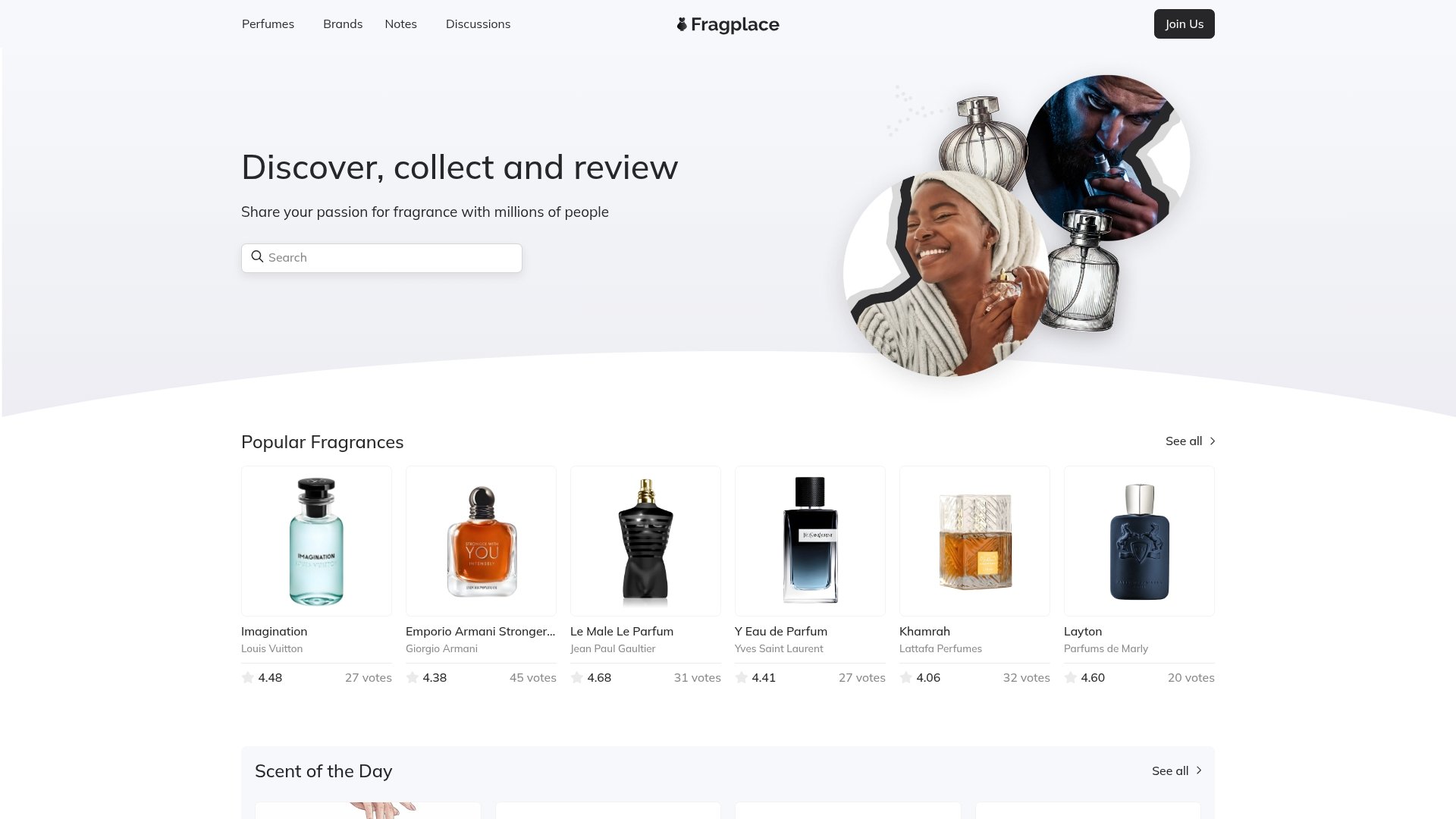
Two things worth doing next. Look up the fragrance you're considering on Fragplace and compare its EDP and EDT versions side by side, with the notes and real user reviews in front of you. Then follow the new releases on the Blog, so the next bottle is a decision rather than a guess.
It's strength. Eau de Parfum (EDP) typically contains 15% to 20% fragrance oils, so it reads richer and lasts longer, while Eau de Toilette (EDT) has 5% to 15% and comes across lighter and more refreshing.
Eau de Parfum holds for 4 to 8 hours against Eau de Toilette's 2 to 4, which is why EDP is the sensible pick for evenings and formal occasions where reapplying isn't practical.
Choose Eau de Parfum for evening events, formal gatherings, or any time you want the scent still there hours later. Eau de Toilette is the better call for daytime wear, professional settings and casual outings, where a subtle aroma is the polite option.
Eau de Parfum leaves a more pronounced trail thanks to its higher concentration of fragrance oils. Eau de Toilette keeps that trail light, which makes it easier to live with in close interactions and professional environments.
| Point | Details |
|---|
| Fragrance Concentration | Eau de Parfum contains 15% to 20% fragrance oils, lasting 4 to 8 hours, while Eau de Toilette has 5% to 15%, lasting 2 to 4 hours. |
| Scent Profile | Eau de Parfum offers a rich, complex scent ideal for formal events, whereas Eau de Toilette provides a fresh, subtle profile suited for daytime and professional use. |
| Selection Considerations | Choose Eau de Parfum for evening or special occasions and Eau de Toilette for everyday and casual settings based on desired scent intensity. |
| Personal Factors | Individual skin chemistry, activity level, environment, and social context significantly influence fragrance performance and should be considered when selecting a scent. |
| Attribute | Eau de Parfum (EDP) | Eau de Toilette (EDT) |
|---|
| Fragrance Oil Concentration | 15% to 20% | 5% to 15% |
| Longevity | 4 to 8 hours | 2 to 4 hours |
| Sillage (Scent Trail) | Noticeable, prominent | Light, subtle |
| Ideal Use | Evening, formal events | Day, professional settings |
| Scent Profile | Rich, complex, lingering | Fresh, delicate, fleeting |
| Personal Factor | Impact on Scent | Best Strategy |
|---|
| Skin Chemistry | Alters note development | Always test before buying |
| Activity Level | Affects longevity | Choose concentration accordingly |
| Environment | Can intensify or mute scent | Adjust strength to setting |
| Social Context | Dictates suitable sillage | Lighter for work, stronger for events |