Articles
Get the Fragletter
New fragrance stories and picks in your inbox. Unsubscribe anytime.
New fragrance stories and picks in your inbox. Unsubscribe anytime.
New fragrance stories and picks in your inbox. Unsubscribe anytime.
New fragrance stories and picks in your inbox. Unsubscribe anytime.
The concentration on the bottle tells you more than the advertising ever will. Over 80 percent of British consumers say fragrance plays a key role in their daily routine, and plenty of them still buy without knowing what separates Parfum from Eau de Parfum from Eau de Cologne. Strength, composition and wear time — once those three click into place, you stop paying premium money for the wrong format.
The names on the bottle are a strength spec, not a quality grade. According to research from Manonmaniam Sundaranar University, these classifications are determined primarily by their concentration of aromatic compounds — so a Parfum isn't a finer perfume than an Eau de Toilette, it's a denser one. That distinction gets blurred constantly by marketing, and it costs people money.
The scale runs from the most intense Parfum (also known as Extrait de Parfum) down to the featherweight Eau de Cologne. What actually shifts as you move along it:
Think of the category as a decision about how much space you want a scent to occupy, and for how long. A heavyweight evening perfume and a bright daytime splash are answering different questions, and buying the wrong one is the most common way to end up disappointed by a scent you liked on paper. Our blog guide on fragrance types goes further into how the categories break down.
Concentration is the whole argument. According to research from the International Journal of Novel Research and Development, the percentage of fragrance oils determines how long a scent lingers and how loud it is.
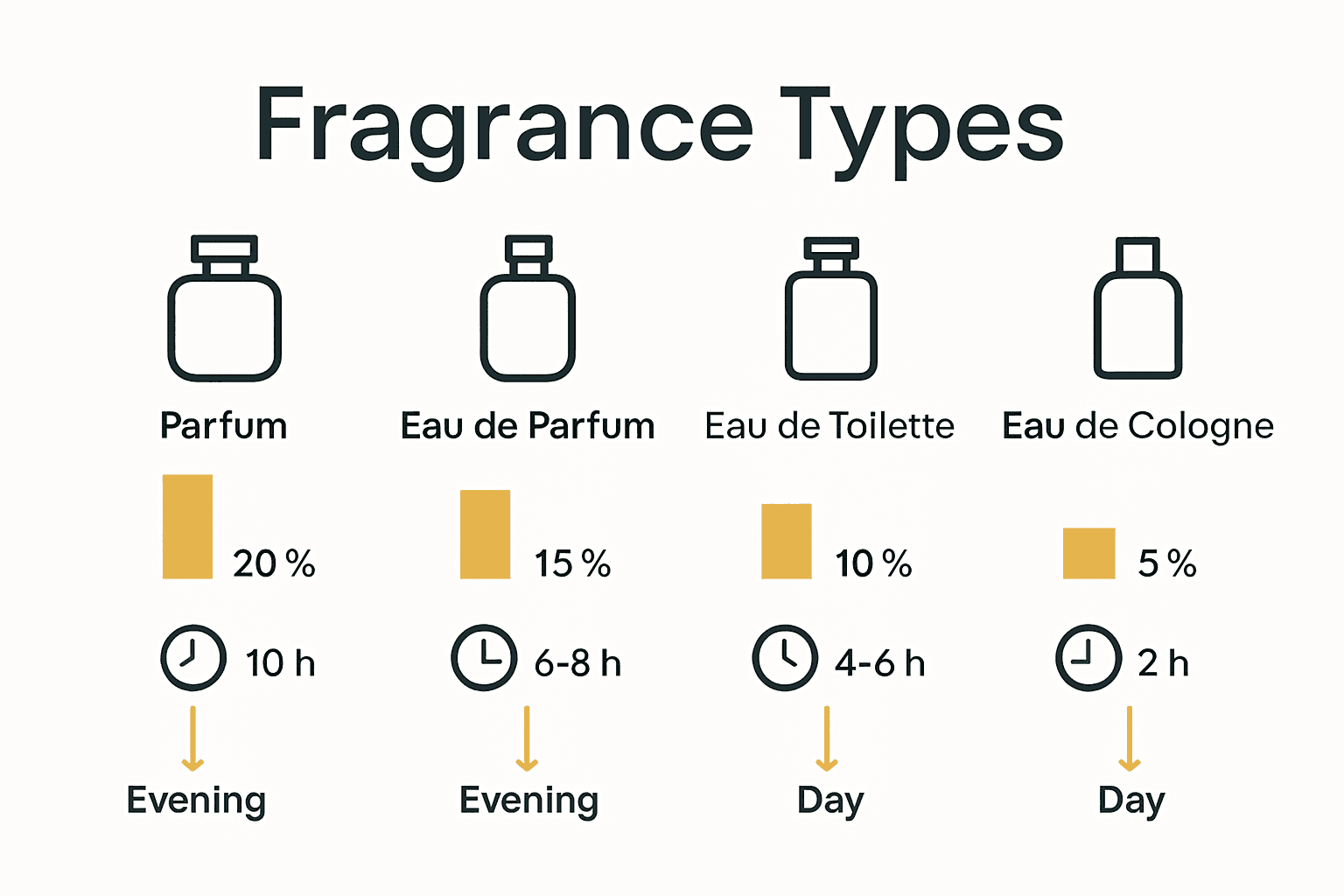
Concentration Levels across fragrance types typically range as follows:
Look at those bands closely. An Eau de Toilette at the top of its range meets an Eau de Parfum at the bottom of its, which is why a well-made EdT can outperform a thin EdP from the same house — and why the label alone is a poor guide to what you'll get. Technical guidelines from the Dubai Municipality note that these concentration variations significantly affect a fragrance's duration and strength, with Parfum offering the longest wear and Eau de Cologne the briefest.
Use the numbers as a starting position, not a promise. A robust evening perfume and a light daytime scent need different concentrations, and the format you choose sets the ceiling on what any perfume can do for you.
Concentration sets the ceiling; formulation decides whether a perfume reaches it. Research from the International Journal of Creative Research Thoughts points to formulation as the thing that determines how a perfume projects, diffuses and interacts with your skin chemistry, with volatility and molecular structure doing much of the heavy lifting.
The components that matter:
Research from the International Journal of Novel Research and Development shows that how the notes are balanced has a real effect on longevity. Top notes deliver the opening burst, middle notes carry the heart, and base notes are what keeps anything on your skin past lunchtime. If a perfume vanishes in an hour, the base is usually the reason — not the price you paid. What is an Eau de Parfum? Understanding Fragrance Layers breaks down how those layers work together.
This is also why the same bottle behaves differently on two people, and why borrowing someone else's recommendation without trying it yourself is a gamble.
Perfumery is chemistry with taste attached — every molecular decision is somebody's creative choice, made on purpose.
Matching concentration to setting is the single easiest upgrade to how you wear fragrance. Guidance from Harry Rosen sets out where each type tends to sit:
Read those as defaults rather than rules — with one exception worth respecting. A full Eau de Parfum in a small shared office is the fragrance equivalent of a loud phone call, and the people around you can't step away from it. Research from Charlotte Tilbury emphasises that personal preference and skin chemistry matter enormously here, and intensity varies dramatically between individuals, so testing on yourself beats any chart. Build a small wardrobe — something light for heat, something denser for evenings — and you'll rarely be caught wearing the wrong weight.
Most bad fragrance purchases start with a myth, not a bad perfume. Analysis from T3 finds that people routinely assume every fragrance performs the same way, ignoring the gaps between concentration levels and how the stuff is applied.
Common fragrance selection myths include:
That third one is the expensive one. Extra sprays don't extend wear time so much as raise the volume, and there's a point where a generous hand tips into a complaint from someone else. Research from Marie Claire highlights that consumers frequently overestimate how their chosen fragrances perform; skin chemistry, environmental conditions and application technique count for more than most people realise. Fragrance Discussions are a good place to see how differently the same bottle behaves for different people.
The fix is patience. Wear a sample for a full day before committing, and let your own skin settle the argument.
If you're buying one bottle and want it to work hardest, buy the Eau de Parfum. At 15-20% oils it carries most of a day without the price tag of an extrait, and it's the format most modern releases are actually designed around. Add a cologne or a lighter Eau de Toilette for hot weather and daytime, skip Parfum until you've found a scent you're certain about, and stop treating price as a proxy for performance — it isn't.
Start by reading the scent profiles and reviews at Fragplace.com to work out which concentration suits how you actually live. Then take your shortlist to Fragrance Discussions and ask the people who've worn it — that's the step most buyers skip, and it's the one that saves you a bottle you'll never finish.
Concentration, and everything that follows from it. Eau de Parfum typically carries 15-20% fragrance oils, so it reads more intense and lasts longer. Eau de Toilette sits at 5-15%, lighter and more refreshing. Neither is the superior format — they're built for different jobs.
Eau de Parfum generally lasts longer on the skin, often 4 to 8 hours. Eau de Toilette usually runs 3 to 5 hours, because there's less aromatic material to work with. Your own skin can push either figure in either direction.
It's not the obvious choice. At 2-5% fragrance oils, Eau de Cologne is built for casual daytime wear and isn't typically recommended for formal settings, where longer-lasting scents do the job better. Wear it anyway if you love it — just plan on topping up.
More than most people expect. Skin type and moisture levels change how a fragrance develops and how long it holds, and conditions like temperature and humidity shift its projection. Dry skin is the usual culprit behind a perfume that seems to disappear.
| Point | Details |
|---|
| Fragrance Classification | Fragrances are categorised based on aromatic compound concentration, affecting intensity, longevity, and price. |
| Concentration Impact | Higher fragrance oil concentrations lead to longer-lasting scents, necessitating informed choices for different occasions. |
| Formulation Considerations | The chemical composition, volatility, and note structure significantly influence scent performance on individual skin. |
| Common Myths | Many misconceptions about fragrance selection exist; understanding personal skin chemistry and environmental effects is crucial for optimal choices. |