Articles
Get the Fragletter
New fragrance stories and picks in your inbox. Unsubscribe anytime.
New fragrance stories and picks in your inbox. Unsubscribe anytime.
New fragrance stories and picks in your inbox. Unsubscribe anytime.
New fragrance stories and picks in your inbox. Unsubscribe anytime.
Eau de parfum is the concentration most people should be buying, and the industry has done a poor job of explaining why. It isn't the strongest thing on the shelf, and that's the point. Between a cologne that's gone before lunch and a parfum that trails you around a room sits a percentage that behaves itself.
Eau de parfum is a concentration, not a quality grade. Worth saying up front, because the phrase gets sold as if it were a compliment. Merriam-Webster keeps it plain: a perfumed liquid carrying a percentage of fragrant oils that exceeds eau de toilette and stays below pure perfume.
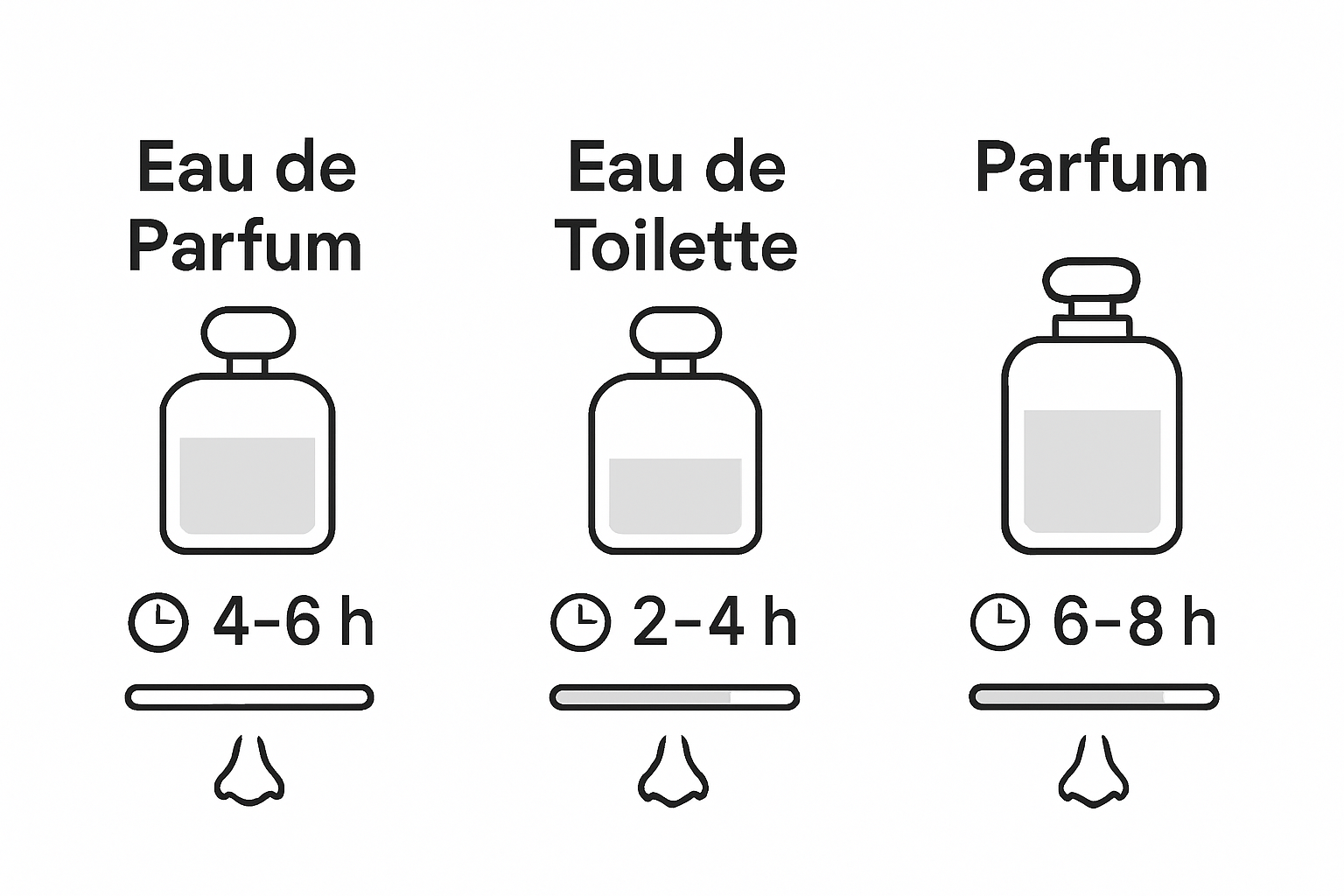
In practice that means roughly 10-20% fragrant essential oils, which is robust without tipping into overpowering, and detectable for 4-6 hours after you spray. That extra oil is why it reads more intense than eau de toilette, and why it's what people reach for when they want the scent to be noticed rather than discovered. If a fragrance you liked smelled wonderful for twenty minutes and then quit on you, concentration was probably the culprit, not the perfumer.
The name explains the mechanism. "Eau" is French for water, "parfum" is the concentrated essence, so the label is describing a dilution and the only useful question is how strong. That middle position — real sillage and longevity without the weight of pure parfum — is why enthusiasts default to it. Understanding fragrance layers is the other half of the picture, because concentration and structure get conflated constantly.
What you're actually paying for:
Concentration is the percentage of aromatic compounds in the bottle, and it sets the ceiling on everything else: intensity, longevity, how much there is to follow. Eau de parfum generally lands at 15-20%. You'll notice that doesn't line up exactly with the 10-20% figure quoted for the same category elsewhere, and that's the honest state of the labelling — treat any published range as a guide rather than a promise.
Structure is a separate matter, and it's where the interest lives. Top notes arrive first: light, volatile, quick to burn off. Middle notes come through shortly after and carry the character of the composition, linking the opening to what sits underneath. Base notes are the slow ones — the depth, and the part you still catch hours later, which is usually what you remember a fragrance for at all.
Exploring different fragrance types shows how small shifts in oil percentage change the result. More concentration buys longevity, stronger projection and a longer development. At 15-20%, eau de parfum stays detectable for 4-6 hours without taking over the room you're standing in, which is the real case for it over parfum.
What that concentration band gives you:
Line the concentrations up and the spectrum stops being mysterious. Eau de cologne is the lightest at 2-4% and typically dissipates within an hour — fine as a refresher you keep re-applying, useless as a signature. Eau de toilette runs 5-15% and gives you two to three hours of a lighter, more transient scent. Parfum tops the range at 20-30% and six to eight hours, and it's a commitment; that much material has to be managed rather than enjoyed passively. Eau de parfum sits between them at 15-20% and four to five hours, and for most buyers it's the better purchase of the two heavier options.
Exploring fragrance varieties is where those distinctions stop being abstract. The middle position is also why one bottle covers a working day and an evening out, from a professional environment to a dinner, without you owning two versions of the same scent.
The spectrum in short:
Longevity is how long a scent stays perceptible. Projection is how far it travels. People conflate the two and then over-spray, which is how a perfectly civilised eau de parfum ends up being the thing everyone in the lift resents. At this strength you get an aura that announces you at conversational distance without flooding the space.
Four to five hours is the working window, and it's worth being straight about what that buys. It covers an evening event, a ceremony or a formal meeting without fading halfway through. A full day from a morning desk to a late dinner will want a top-up, and anyone telling you otherwise is selling something.
The pay-off is the development. Top notes open with an immediate burst, then the middle and base come through, so what you're wearing at hour four isn't quite what you sprayed at the start. That evolution is the argument for a proper concentration over something lighter, where the scent often disappears before it gets anywhere.
Where it earns its place:
The most tedious belief in this hobby is that a higher concentration means a better perfume. It doesn't. The 15-20% band is a calibration between intensity and wearability, and a well-built eau de parfum beats a clumsy parfum every time. Percentage tells you how much material is in the bottle, never how good the material is.
The second myth is that eau de parfum belongs to the evening. Also wrong. It works in an office, at lunch, at a casual gathering — the strength is manageable, and treating it as after-dark only means leaving a bottle unused six days a week. Related to that is the assumption that more concentrated automatically means overbearing. How much you apply matters more than what's printed on the box, and the right amount depends on your body chemistry, skin type and personal preference.
Then there's price. Eau de parfum usually costs more than the lighter version of the same scent, which is fair enough, but across brands the price tag tracks marketing far more closely than it tracks oil percentage. A concentration label is not a quality guarantee, and paying more doesn't buy you a better composition.
Common misconceptions debunked:
If you can only own one version of a scent you like, buy the eau de parfum. That 15-20% blend gives the base notes time to arrive and keeps the whole thing on you long enough to matter, which is the point of spending money on perfume at all. The exceptions are honest ones: in real heat, or with something already heavy, the lighter version can be the smarter buy, and if you need a scent to outlive a long night, go up to parfum and spray less.
Two things worth doing next. Read the profiles, reviews and community discussions at Fragplace.com, where people describe how a specific bottle behaves rather than what a concentration chart predicts. Then work out which style suits you before you spend, starting with 7 Essential Eau de Parfum Types You Need to Know.
A fragrance concentration containing roughly 10-20% fragrant essential oils. That puts it above lighter types like eau de toilette, so it holds on the skin considerably longer.
Around 4 to 6 hours after application. Longer than the lighter concentrations, though not long enough to skip a top-up on a full day.
A 10-20% fragrance oil concentration, better longevity than eau de toilette, and an intensity that suits evening wear and special occasions without becoming a burden.
It carries more fragrance oil than eau de toilette (5-15%) and eau de cologne (2-4%), and less than pure parfum (20-30%). That middle ground is exactly why it's the sensible default for a scent you want noticed but not endured.
| Point | Details |
|---|
| Eau de Parfum Concentration | Eau de Parfum typically contains 15-20% fragrance oils, offering a balance between lighter and heavier scents. |
| Longevity and Projection | This concentration allows Eau de Parfum to last approximately 4-6 hours, making it ideal for various occasions. |
| Versatility in Use | Contrary to common misconceptions, Eau de Parfum is suitable for both day and evening wear, fitting seamlessly into diverse social settings. |
| Common Misunderstandings | Many believe higher concentration equals better quality; however, Eau de Parfum’s value lies in its balanced intensity and adaptability. |