Articles
Get the Fragletter
New fragrance stories and picks in your inbox. Unsubscribe anytime.
New fragrance stories and picks in your inbox. Unsubscribe anytime.
New fragrance stories and picks in your inbox. Unsubscribe anytime.
New fragrance stories and picks in your inbox. Unsubscribe anytime.
Designer fragrance gets treated as perfumery's cheap seats, and that snobbery is lazy. What you're buying is a composition by a working perfumer, then sanded smooth enough to sell at an airport counter — sometimes that sanding kills it, sometimes it produces a modern classic. Here's how to tell which one you're holding.
A designer fragrance is one sold under a fashion or lifestyle house's name rather than a dedicated perfume house's. That's the whole definition. Everything else people pin to the word — the assumed cheapness, the forum eye-roll — is reputation rather than formula.
What separates designer from niche is business model, not talent:
Read that list again and the real trade-off shows up. Broad appeal means a scent has to work on a lot of people in a lot of rooms, and that tends to round off the strange edges that make a perfume memorable. It doesn't mean the blending is careless. Designer houses hire the same renowned perfumers the niche world queues up for, and hand them bigger budgets.
Brand Identity and Fragrance Creation
Fragrance is the cheapest door into a luxury house. Most people will never buy the coat, so the bottle has to carry the brand's story alone — which is why designer briefs talk about mood and customer long before they talk about materials.
Common Fragrance Misconceptions
Two myths do most of the damage here:
Niche is a distribution strategy, not a quality certificate. There's plenty of dull, overpriced niche out there, and a well-made designer bottle beats it on any given day.
Pro tip: Judge the juice, not the label on the box. Brand worship and brand snobbery are both bad shopping guides.
The word on the bottle — parfum, toilette, cologne — describes concentration, and shops sell it as a quality ladder. It isn't one.
The primary types of designer fragrances can be categorised into several key classifications:
Concentration and Complexity
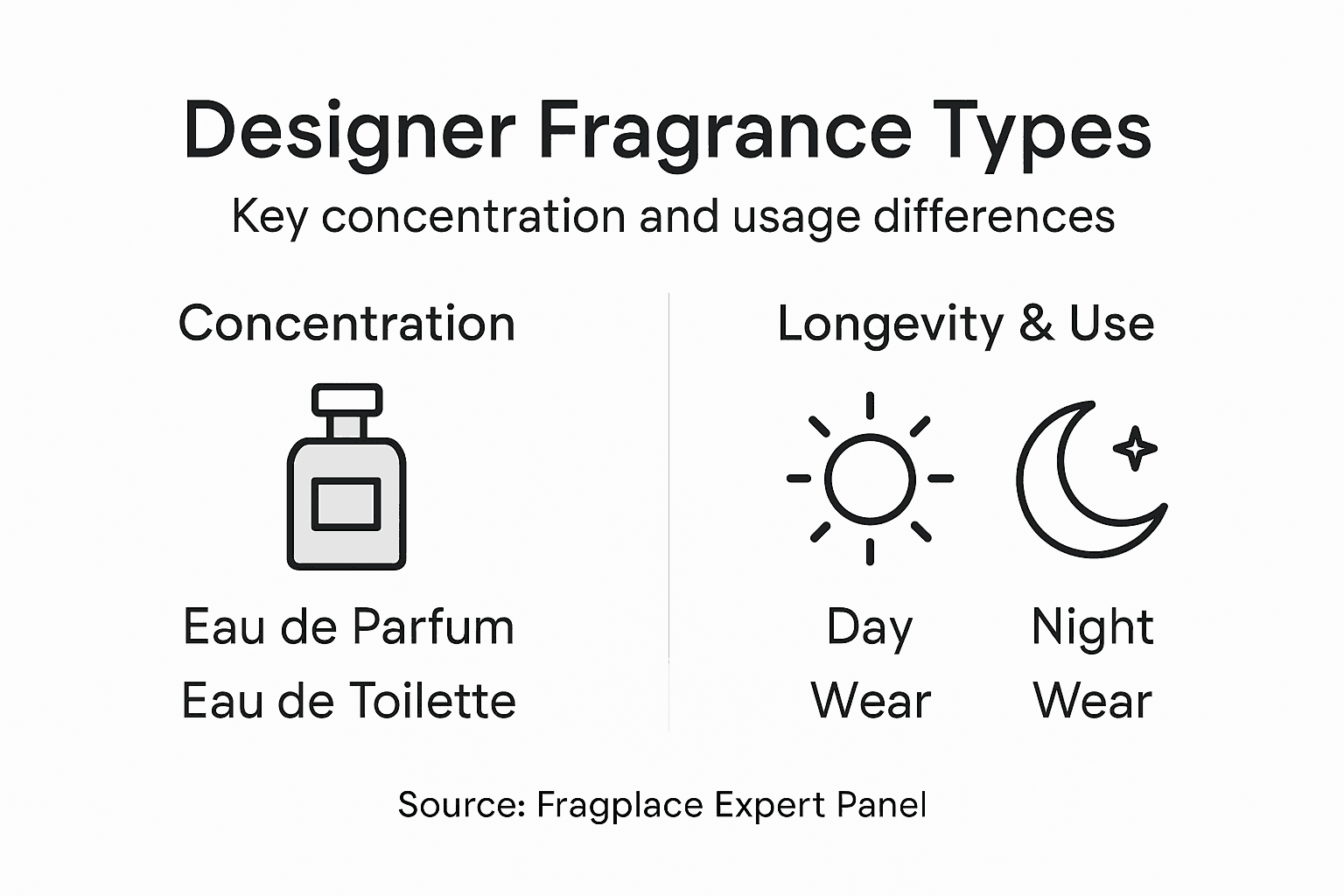
Eau de Parfum typically contains 15-20% pure fragrance oils, which gives it more weight and staying power than an Eau de Toilette at roughly 5-15%. Useful to know, easy to over-read. Concentration measures how much oil is in the bottle, not how good the perfume is or how loud it smells — a resinous EDT can outlast a thin, citrus-led EDP sitting at a higher percentage.
Here's how the concentrations line up, and where each one earns its place:
Olfactory Families and Composition
Designer fragrances are further distinguished by their olfactory families:
Treat those labels as a rough map. Oriental in particular does far too much work, covering everything from powdery vanilla to smoky resin, so it tells you where to start looking and almost nothing more.
Ingredient Selection and Brand Philosophy
Some houses lean on rare botanical extracts, others build around synthetic molecules that don't exist in nature. The naturals-are-better reflex is worth dropping: some of the most distinctive designer work of the past few decades is synthetic showpiece material, and a clumsily used natural smells like potpourri.
Concentration tells you how much oil is in the bottle. It tells you nothing about whether the perfume is worth wearing.
Pro tip: Choose the concentration for the room you'll be in, not for the prestige. Office wear rarely needs an extrait.
A designer perfume is two products in one: a formula, and a campaign built to sell it. Hold those apart in your head and the whole category gets easier to shop.
The fragrance development process typically involves several critical stages:
Notice where the brand narrative sits. First. The story often exists before the smell does, and the perfumer is asked to hit a brief written by people thinking about shelf space.
Professional Collaboration
Perfumers — 'noses' — don't work alone on these. They sit alongside brand evaluators, marketing specialists and consumer insight teams, and every round of testing pulls the formula towards the middle. That's the honest cost of the model: consensus is safe, and safe is rarely thrilling. It's also why designer releases are so reliably wearable, which is exactly what most buyers want.
Marketing Strategies
Global campaigns turn scents into lifestyle statements through:
None of that reaches your skin. A famous face on the poster says nothing about the drydown, and the fragrances with the loudest campaigns are often the ones that most need one.
Marketing sells you the story. The bottle still has to deliver the smell.
Pro tip: Read the campaign as information about the brand's ambitions, then ignore it completely at the testing counter.
A signature accord is a house's handwriting — the thing you recognise across a whole line before you read the label. Done well, it's the most valuable asset a brand owns. Done to death, it becomes a signature-scent cliche you can smell in every lift.
The key components of signature fragrance development include:
Olfactory Storytelling
Notes carry associations, and perfumers use them the way writers use loaded words. A woody base reads as sophistication; citrus up top reads as freshness and vitality. Those meanings are conventions rather than laws, which is why the most interesting compositions break them on purpose.
Brand Identity and Consumer Psychology
Buying a designer fragrance is rarely about the smell alone. Brands build scents that do social work:
There's a trap in that list. A scent chosen entirely for what it signals tends to sit on you like borrowed clothes, and people can tell. If you're torn between a bottle you admire and a bottle you'd actually reach for on a Tuesday morning, take the Tuesday one.
A designer fragrance is not just a scent, but a portable extension of personal identity.
Marketing and Emotional Resonance
The strongest designer scents work because they give people a way to describe themselves without speaking. That's genuine. It's also the lever brands pull hardest, because the same psychology that makes a perfume meaningful is what lets a house charge a premium for it.
Pro tip: Live with a sample for a full day before deciding. If you keep forgetting you're wearing it, it isn't your signature.
Now the part the campaign leaves out: what you're paying for, and what your skin might object to.
Key considerations in fragrance selection include:
Ingredient Safety and Regulatory Risks
Both synthetic and natural components can trigger allergic reactions or skin sensitivities. Natural doesn't mean gentle. Regulators keep tightening safety standards and disclosure rules, which is why long-standing formulas get reworked and why some old favourites no longer smell the way people remember. If your skin is reactive, the ingredient list matters more than the notes pyramid.
Pricing Dynamics
Here's what sits inside a designer price tag, and where you can push back:
Broadly, the drivers are:
Heavy bottle, thin juice is a real pattern, and it's the clearest sign your money went into the glass.
The true cost of a designer fragrance encompasses far more than its liquid contents.
Alternative Fragrance Options
If the markup annoys you, there are ways out:
Ranked honestly: independents are where the surprising work happens, niche houses give you character at a price you'll feel, and dupes buy you the shape of a scent without its depth. A dupe is a decent stand-in and a poor substitute for something you love.
Pro tip: Always request fragrance samples or testers before buying a full bottle — for skin compatibility as much as for taste.
The verdict: designer fragrance is worth your money when you buy it for the smell and ignore everything on the poster. Sample before you commit, pick the concentration that suits the room rather than the price list, and if a bottle's appeal is mostly the name, go and find the lesser-known house doing the same accord with more nerve. The category's weakness is timidity, not quality — so back the releases that take a risk.
Start with 7 Must-Know Top Perfume Trends 2025 for Collectors to see where the category is heading, then bring your own verdict to Fragplace and argue it out with people who care as much as you do.
Scents created by luxury fashion houses and brands, built to carry the brand's identity and to appeal to a broad audience rather than a small one.
Designer fragrances come from established brands, are shaped by extensive market research and aim at wide appeal. Niche perfumes chase unique compositions for smaller target markets. It's a difference of ambition and distribution, not automatically of quality.
Brand prestige, marketing investment, packaging design and distribution channels, plus the perceived luxury value attached to the name. Little of that is the liquid.
The olfactory family, the concentration, your personal style and the occasion you're buying for — and whether you'd still want it if the label were blank.
| Point | Details |
|---|
| Designer Fragrances are Artistic Expressions | They serve as complex representations of brand identity rather than generic commercial products, highlighting creativity in formulation and storytelling. |
| Understanding Fragrance Types is Essential | Different types such as Eau de Parfum and Eau de Toilette cater to varying occasions and preferences, with distinct oil concentrations affecting longevity. |
| Consumer Psychology Matters | Signature notes in fragrances tap into personal identity and emotional resonance, making them powerful symbols that communicate lifestyle narratives. |
| Consider Alternatives and Costs | Buyers should be aware of potential allergenic ingredients and explore budget-friendly alternatives like niche brands while understanding pricing factors. |
| Fragrance Type | Concentration Range | Typical Longevity | Suggested Usage |
|---|
| Eau de Parfum | 15-20% oils | 6-8 hours | Evening, special occasions |
| Eau de Toilette | 5-15% oils | 3-5 hours | Daily, office wear |
| Cologne | 2-5% oils | 2-3 hours | Daytime, casual events |
| Perfume Extrait | 20-40% oils | 8-12 hours | Formal or signature scent |
| Cost Factor | Impact on Price | Budget-Friendly Tip |
|---|
| Brand Prestige | Increases significantly | Consider lesser-known luxury brands |
| Marketing Investment | Raises prices considerably | Avoid limited-edition launches |
| Packaging | Adds notable premium | Choose minimalist bottle designs |
| Distribution Channel | Can raise final retail cost | Buy from authorised online retailers |