Articles
Get the Fragletter
New fragrance stories and picks in your inbox. Unsubscribe anytime.
New fragrance stories and picks in your inbox. Unsubscribe anytime.
New fragrance stories and picks in your inbox. Unsubscribe anytime.
New fragrance stories and picks in your inbox. Unsubscribe anytime.
Most of the confusion here has nothing to do with taste. It's arithmetic — how much perfume oil is in the bottle, and how long that keeps you smelling of anything at all. More than 60% of shoppers mistake one for the other due to subtle differences in concentration and character.
The words on the box are less poetic than they sound. Cologne and eau de toilette aren't two moods or two philosophies — they're two dilution brackets, and the gap between them decides almost everything about how the bottle behaves on you.
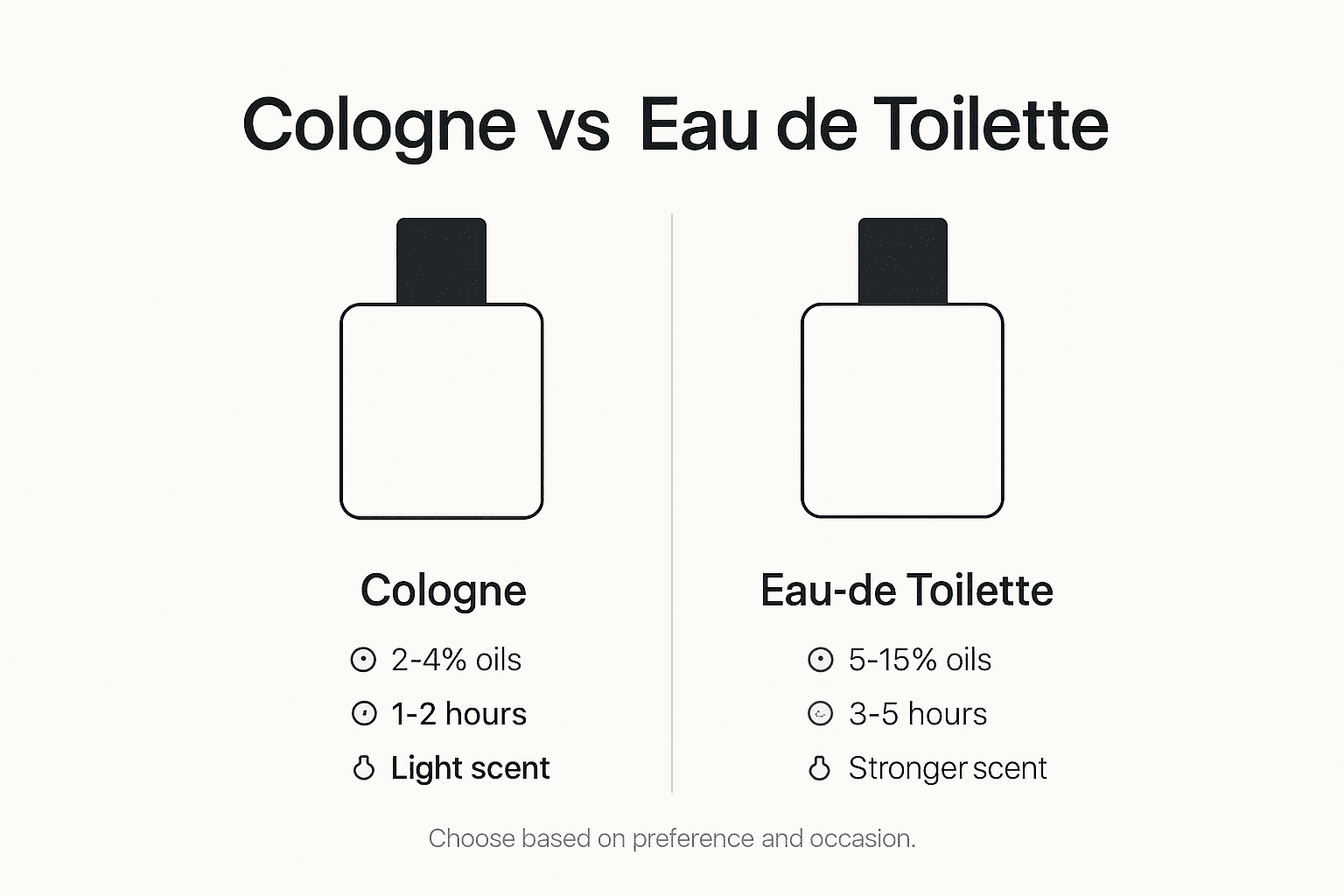
Cologne sits at 2-4% essential oils. That's a thin solution by design: bright, quick to read, quick to go. Eau de toilette runs 5-15%, which is a wide bracket and worth remembering when you're comparing prices — an EDT scraping the bottom of that range and one near the top are not the same product, whatever the label says.
So the practical difference is duration and volume, not quality. Cologne is the format you reach for in heat, when you want something clean rather than something that announces itself. Eau de toilette is the workhorse — enough oil to survive a working day, not so much that it follows you into a lift and stays there. Neither is the superior category. One's just louder.
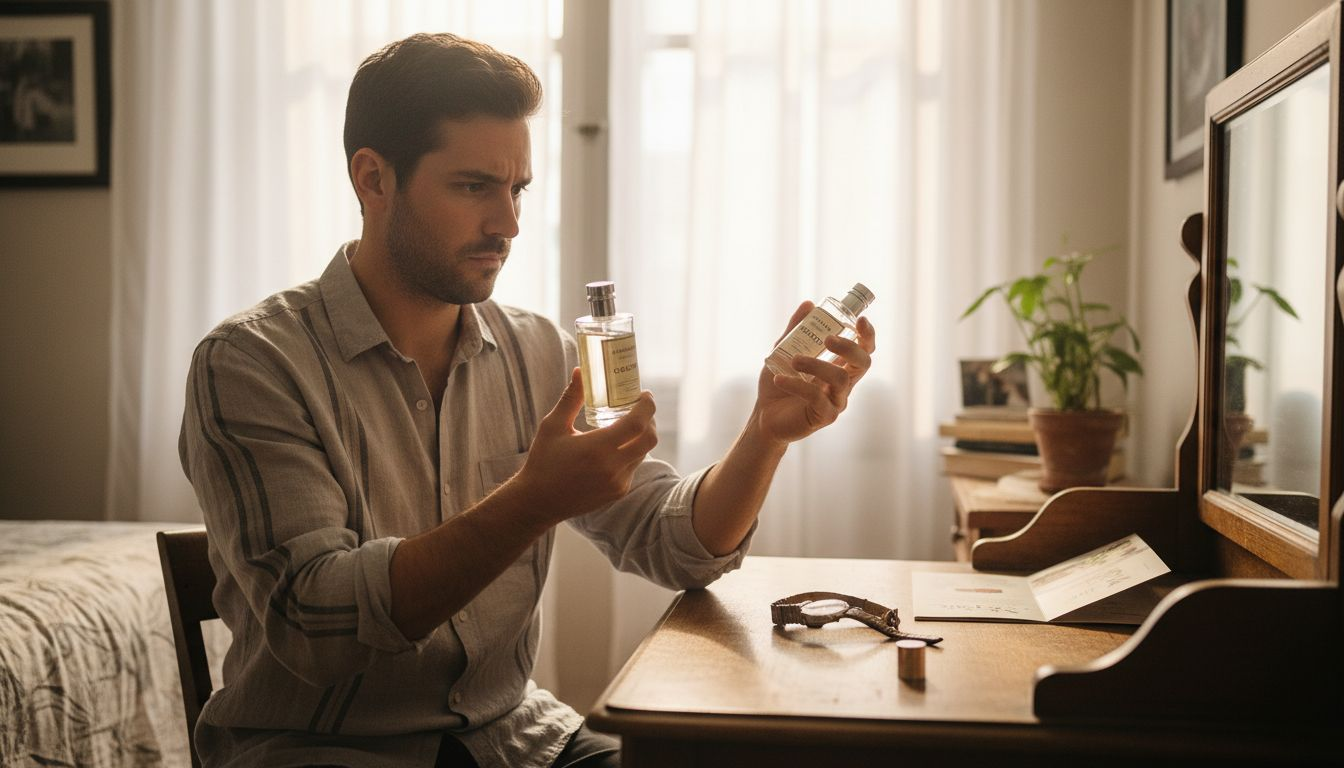
Pro tip: Test on pulse points — wrists, neck — rather than a paper strip. Body heat is what pushes a fragrance through its stages, and paper won't tell you how it settles on you.
Here's a quick comparison of common fragrance formats to help guide your selection:
Concentration doesn't only make a scent stronger. It changes which parts of the composition you actually get to meet.
At 2-4%, the top notes do the talking and then leave. There's rarely time for a base to develop, which is why so many colognes read as a single bright idea rather than a structure. Push the oil load up and the heavy materials — the resins, the woods, the musks — get their moment; if you want to see what that looks like in practice, the fragrance layers in eau de parfum are where the architecture becomes obvious.
Heat is the other half of the equation. A 2-4% formula disperses fast, which is a virtue in August and a liability in an air-conditioned office where you'll want to reapply by lunch. A 15-20% formula unfolds slowly and keeps unfolding for hours — glorious in December, occasionally oppressive in a crowded room. Match the number to the weather before you match it to your mood.
Pro tip: Try the same fragrance at different times of day. A concentration that feels perfectly judged at 8am can feel like too much by 6pm, and that's information worth having before you buy the full bottle.
Longevity and projection get treated as one thing. They aren't. A fragrance can sit close to the skin for eight hours, and another can fill a room for two and then vanish — those are different products for different evenings.
Projection is the radius. Cologne keeps that radius small, which is a feature: it's a scent for people standing near you, not for the far end of a meeting table. Eau de toilette and anything above it widen the circle, and the different eau de parfum types show how far that can be taken. Bigger isn't better. Bigger is just harder to take back.
Context should decide the format more than preference does. Offices are shared air, so keep it restrained and clean there — nobody has ever been complimented for a scent that arrived before they did. Evenings can carry the heavier, slower material. Close-quarters occasions reward something that stays quiet and reveals itself gradually rather than something engineered to be noticed across a bar.
Pro tip: Apply to pulse points and let body heat do the diffusing rather than over-spraying. Two well-placed sprays outperform six scattered ones, and they're far kinder to everyone around you.
This table summarises how different factors influence fragrance projection and longevity:
Gender stereotyping in perfumery is a shelving decision dressed up as chemistry. Nothing in a formula knows who's wearing it.
The convention has been to file cologne as masculine and eau de toilette as the more neutral option, with men's scents leaning woody and musky and women's built around denser floral structures. That split was a marketing habit, and research on gendered fragrance marketing has been fairly blunt about how narrow it made the category. It's also why so many people spend years avoiding an entire half of the shop for no reason at all.
The packaging language is just as transparent once you notice it: angular bottles and dark palettes on one side, soft curves and pastels on the other, with the advertising doing the rest of the work. Buyers have largely stopped playing along, and the trade has followed them — slowly, and mostly because it had to.
Pro tip: Ignore which side of the counter a bottle sits on and smell it first. The label is the last piece of information you need, not the first.
If you're buying one bottle, buy the eau de toilette. It's the format that covers the most ground for the money, and a cologne you love will still leave you reapplying at noon.
Beyond that, your routine decides more than your taste does. If you're moving all day, or working somewhere with tight shared air, the lighter cologne formulations are the sensible choice. If you want something that's still with you at dinner, the higher concentrations and the different eau de parfum types are the better spend. Climate matters more than most people allow for — the same bottle behaves differently in a Scottish January and a Spanish July.
A small wardrobe beats one heroic purchase. Something light for daytime, something denser for evenings, and you've covered most of your life without owning fifteen bottles you never finish. Build it slowly through samples; the format that suits your week is rarely the one that impressed you on the blotter.
Pro tip: Live with a sample for a few hours before committing. Body chemistry can shift a scent's dry-down considerably, and the last hour tells you more than the first ten minutes.
The verdict: eau de toilette is the better buy of the two for almost everyone, because 5-15% oil gives you a scent that survives a real day. Cologne earns its place as a second bottle — hot weather, early starts, offices where restraint is the point — not as your only one. Buy the EDT first, add the cologne when summer makes you want it.
Two things worth doing next. Read the honest reviews and track the bottles you're weighing up at Fragplace.com, then take the argument to the people who've already made the mistake you're about to — the Community of fragrance passionates will tell you which EDTs punch above their price and which are coasting on a name.
Oil content, and everything that follows from it. Cologne sits at 2-4% essential oils, so it reads light and refreshing; eau de toilette carries 5-15%, which makes it more pronounced and considerably more persistent.
Cologne gives you roughly 1-2 hours. Eau de toilette runs about 3-5 hours, which is the difference between reapplying at lunch and not thinking about it again.
Heat, mornings and casual plans — that's cologne's territory. Eau de toilette is for everything else, especially daily wear and social settings where you want the scent to still be there an hour in.
More oil means a stronger scent, longer wear, and enough time for the composition to actually develop. Less oil keeps things light and close to the skin, which suits close-quarters interactions and little else.
| Point | Details |
|---|
| Fragrance Concentration | Cologne contains 2-4% essential oils for a light scent, while eau de toilette has 5-15%, offering more intensity and longevity. |
| Situational Use | Lighter fragrances like cologne are ideal for daytime and casual settings, whereas eau de toilette suits social occasions and daily wear. |
| Gender Considerations | Traditional gender stereotypes in fragrance marketing are evolving, encouraging consumers to choose scents based on personal preference rather than gender. |
| Application Technique | Testing fragrances on pulse points enhances their projection and development, allowing for a better assessment of how they interact with individual body chemistry. |
| Format | Essential Oil % | Typical Longevity | Best Use Scenario |
|---|
| Cologne | 2-4% | 1-2 hours | Daytime, warm weather, casual events |
| Eau de Toilette | 5-15% | 3-5 hours | Daily wear, social settings |
| Eau de Parfum | 15-20% | 6-8 hours | Evenings, special occasions |
| Parfum/Extrait | 20-30% | 8+ hours | Formal events, colder climates |
| Factor | Impact on Projection | Impact on Longevity |
|---|
| Essential Oil Level | Higher oils, stronger | More oils, lasts longer |
| Body Chemistry | Alters scent character | Affects duration |
| Climate/Temperature | Warmth disperses faster | Cooler retains scent |
| Application Method | Pulse points boost throw | Layering extends presence |